

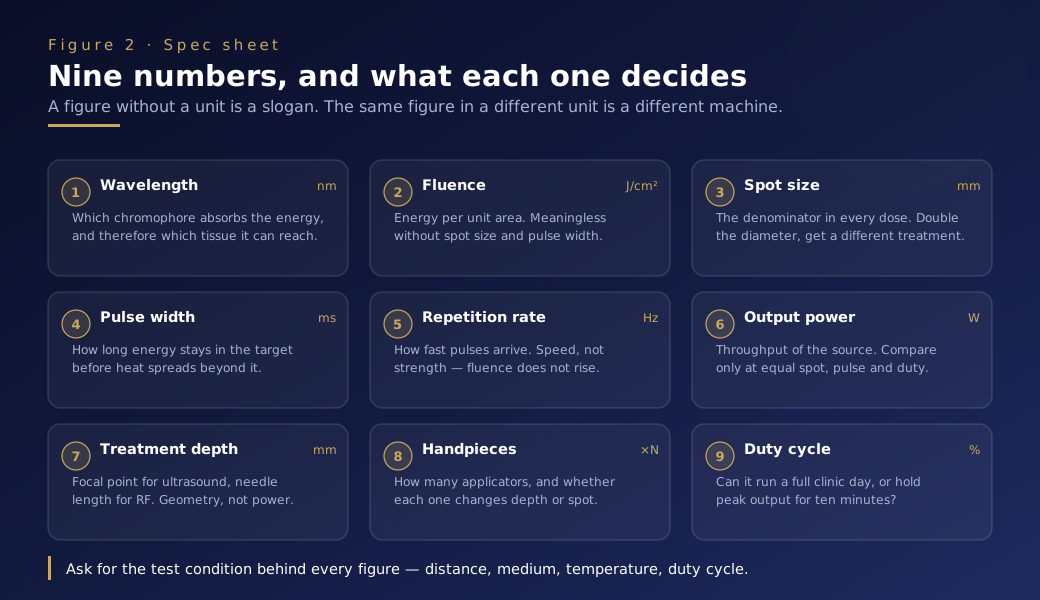
Short answer: the biggest number on a datasheet is usually the one that matters least. Aesthetic machines are sold on a single headline figure — watts, joules, hertz — and bought on a set of figures that only mean something together. This guide covers the nine numbers that decide what a machine can actually do, the unit traps that make two similar-looking sheets describe very different hardware, and the questions that turn a brochure into a specification you can hold a supplier to.
A Specification Is Three Things, Not One
An honest figure has a value, a unit and a test condition. Drop any of the three and it stops being a specification and becomes a claim. "20 J/cm²" is a claim. "20 J/cm² at the handpiece tip, 8 mm spot, 10 ms pulse, measured at 25°C ambient" is a specification, because another engineer could reproduce it.
This is the first filter to apply to any quote you receive. When a sheet gives you a number with no condition attached, you are not looking at an incomplete document — you are looking at a document written to be compared against nothing.
| What the sheet says | What it leaves out | What to ask |
|---|---|---|
| 20 J/cm² | At which spot size, and at the tip or the source? | Fluence at the handpiece with the spot size used |
| 3000 W | Input draw or optical output? | Optical output at the handpiece, plus supply rating |
| 1–10 Hz | Does energy hold at 10 Hz? | Fluence at maximum repetition rate |
| 5 handpieces | What does each one change? | Depth or spot size per handpiece, included or optional |
| Continuous mode | For how long, at what ambient? | Duty cycle and rated continuous output |
1. Wavelength (nm): The Menu, Not the Power
Wavelength decides which tissue absorbs the energy, and therefore what the machine can be sold for. A platform listing 532, 755, 1064 and 10,600 nm is not four times more powerful than a single-wavelength unit — it is four different treatments sharing one box. The number tells you the menu; the energy at each wavelength tells you whether the menu is usable.
Ask two follow-ups. First, whether each wavelength has its own source or is derived from one beam, because derived wavelengths usually lose energy. Second, what the maximum fluence is per wavelength, since a sheet that quotes one figure for a four-wavelength platform is quoting the best case. We go deeper into this in our guide to picosecond wavelengths and in the physics of selective photothermolysis.
2. Fluence (J/cm²): A Dose Needs a Denominator
Fluence is energy per unit area — the closest thing in aesthetics to a dose. It is also the most abused figure on the sheet, because the same fluence at two different spot sizes is not the same treatment. Double the spot diameter and you quadruple the area, so the same 20 J/cm² now delivers four times the energy per pulse into deeper tissue.
So never compare fluence without spot size and pulse width beside it. Ask for fluence measured at the handpiece output, not at the source, because optics and fibres lose energy on the way. And if a supplier quotes a range, ask which end of the range is achievable at the repetition rate you will actually use.
3. Spot Size (mm): The Number Hiding in Plain Sight
Spot size is the denominator in every dose calculation and it is often missing entirely. A nominal 10 mm spot may measure 8 mm at the working distance; a rectangular diode stack is not a circle; a focused handpiece has a waist, not a spot. For anything you will compare across suppliers, ask for the measured spot at the treatment distance.
This matters most in hair removal and pigment work, where coverage per pulse sets both speed and comfort. Two machines at the same fluence, one with a 10 × 10 mm square and one with a 12 mm circle, differ by roughly 13% in area — and that is before anyone mentions the pulse.
4. Pulse Width (ms, µs, ns): How Fast the Energy Lands
Pulse width is the duration of a single delivery, and it decides whether heat stays in the target or spreads into what you did not aim at. Millisecond pulses suit hair follicles and bulk heating. Nanosecond and picosecond pulses concentrate energy fast enough to fragment pigment before the surrounding tissue absorbs it. Continuous output, as on a CO2 laser, is a different mechanism again — ablation rather than a discrete pulse.
A sheet that lists only "pulsed mode" without durations is hiding the number that governs the treatment. Ask for the minimum and maximum pulse width and whether it is adjustable in steps or selected from fixed presets.
5. Repetition Rate (Hz): Speed, Not Strength
Hertz is pulses per second. Ten hertz means ten pulses, each at whatever fluence you set — it does not mean ten times the energy of one hertz. What it does mean is a faster treatment and more heat stacking in the same area, which is why high repetition rates demand more cooling discipline, not less.
Here is the question most buyers never ask: does the machine hold its maximum fluence at its maximum repetition rate? On many systems the answer is no, because the power supply cannot recharge fast enough. The datasheet quotes the best fluence and the best frequency separately; the clinic experiences them together.
6. Output Power (W): Throughput, Not Intensity
Watts describe how much energy the source can deliver per second. They say nothing about how concentrated that energy is at the skin — a wide beam at high power can be gentler than a narrow beam at low power. This is why "3000 W" on a quote tells you almost nothing on its own, and why it is frequently the input draw of the power supply rather than the optical output of the device.
Compare optical output at the handpiece, at the same spot size, pulse width and repetition rate. If a supplier cannot separate input power from output power, that is itself an answer.
7. Treatment Depth (mm): Geometry, Not Energy
For focused ultrasound, depth is set by the transducer's focal length, not by power. A 4.5 mm cartridge is not "stronger" than a 3.0 mm cartridge; it is aimed at a different layer — the SMAS rather than the deep dermis. For radiofrequency microneedling, depth is physical needle length, and energy is released at the tip. For lasers, depth is a consequence of wavelength and fluence, not a setting you dial in.
Ask how depth is specified. "Reaches 4.5 mm" is not the same as "focal point at 4.5 mm", and the difference decides whether the energy lands where the anatomy is. Our HIFU depth guide and RF microneedling explainer cover the geometry in detail.
8. Handpieces: The Real Treatment Menu
A count of five handpieces is a marketing number until you know what each one changes. Three depths of the same applicator is a different offer from one applicator plus a body tip, a facial tip and a cooling head. Ask for the list, the depth or spot each one covers, and — the part that decides your cost per treatment — which of them are included and which are bought later.
Consumable pricing belongs in the same conversation. A handpiece that needs a cartridge every few hundred pulses behaves very differently on the balance sheet from one that does not, which is the subject of our consumable lock-in guide.
9. Duty Cycle and Continuous Rating
Duty cycle is how long the machine can run at a given output before it must rest, expressed as a percentage or as an on/off pattern. It is the difference between a demo and a clinic day. A unit that holds peak output for ten minutes and then derates is not lying — it is specifying a duty cycle in the least useful way possible.
Ask for the continuous rating and the ambient temperature it assumes. If your treatment room runs warmer than the test bench, the real duty cycle is shorter than the sheet says.
The Three Unit Traps
- Millijoules against joules. One joule is a thousand millijoules. Fractional RF devices often quote energy per pin in mJ while lasers quote fluence in J/cm²; the numbers are not comparable and the units make them look closer than they are.
- cm² against mm². One square centimetre is one hundred square millimetres. A figure quoted per cm² describes an area one hundred times larger than the same figure per mm², which is why the unit matters more than the number attached to it.
- Peak against average power. A short pulse can have enormous peak power while its average power is modest. Both are true, and quoting the larger one without saying which it is changes the meaning of the sentence.
What the Sheet Leaves Out
Three things matter to a clinic and almost never appear on a datasheet: how the machine behaves in month fourteen, what the software is like to operate with a client in the chair, and what the service response looks like when something fails on a Saturday. None of them is a number, and all of them affect your cost per treatment more than a 10% difference in fluence.
This is why a spec sheet should be one input into a purchase, not the purchase itself. We built a weighted procurement scorecard for exactly that reason, and it treats documentation, service and consumable independence as scored categories rather than afterthoughts.
Five Questions to Send Before You Compare Quotes
- Send the datasheet for this exact model, including the model number and the serial of the unit you are quoting.
- State the test conditions behind fluence, spot size, pulse width and repetition rate.
- Send the test report for the model, not a certificate for a family of products.
- List every handpiece included, what each one changes, and the price and lifespan of its consumables.
- Confirm the declaration of conformity names this model and your destination market's voltage and plug type.
Ask in writing, and keep the answers with the quote. A supplier who answers all five is worth a second conversation even at a higher price. Our import compliance guide explains what to do with the documents once they arrive.
A Worked Comparison
Two quotes land in your inbox. The first reads: "3000 W, 1–10 Hz, up to 20 J/cm², 5 handpieces." The second reads: "800 W optical at the handpiece, 1–10 Hz, 10–20 J/cm² at an 8 mm spot, 0.5–300 ms pulse width, 4 handpieces plus 2 optional, 60% duty cycle."
The first quote is not necessarily the weaker machine. It is simply unreadable — there is not enough information in it to compare anything. The second can be checked, challenged and held to. That asymmetry is the entire point of reading specifications: you are not looking for the biggest number, you are looking for the supplier who is willing to be specific.
If the first supplier, when asked, produces the same detail as the second, you now have a real comparison. If they cannot, you have a different kind of answer, and it is worth more than any discount.
How We Publish Our Own Numbers
We list optical output at the handpiece, spot size, pulse width range, repetition rate and duty cycle for each platform, and we name the handpieces included with the unit rather than the ones available later. You can see how that reads on the HIFU range, the laser platforms and the RF devices, or compare everything in the catalogue.
If you have a quote from another supplier and want a second opinion on what the numbers mean, send it to us. We will tell you what is specified, what is missing, and what we would ask before signing — whether or not you buy from us.
Frequently Asked Questions
What is the most important number on an aesthetic machine spec sheet?
There is no single one. Fluence, spot size and pulse width act as a set: change any one of them and the treatment changes. If a supplier will only give you one figure, ask for those three, with the test conditions attached.
Is a higher wattage machine always stronger?
No. Wattage describes throughput, not intensity at the skin. A machine can have high output power and a large spot that spreads the energy thinly. Compare optical output at the handpiece at the same spot size, pulse width and repetition rate.
What does J/cm² actually mean?
It is energy density: joules delivered per square centimetre of treated area. At the same fluence, a larger spot delivers more total energy per pulse, which is why fluence without a spot size is an incomplete specification.
Why do two machines with the same fluence feel different on the skin?
Because fluence is only one of several variables. Spot size, pulse width, cooling and the way the handpiece is moved all change what the client feels. That is also why a demo is not a substitute for the numbers.