Three wavelengths are not three power settings. Each one stops at a different depth and is absorbed by a different target, and that decides what the handpiece is good at.
A picosecond laser with three wavelengths gets sold with a sentence like "covers all pigment depths and colours." That may be true, but it skips the part a buyer actually needs: why three, and what you lose when you pick the wrong one.
The answer is two curves — how strongly a target absorbs a wavelength, and how far that wavelength travels before it is absorbed. Everything else, including pulse duration, sits on top of those two facts.
Short Pulses, So Heat Never Gets a Chance
We covered the general principle in selective photothermolysis explained, and compared picosecond against Q-switched as a purchase in Picosecond vs Q-Switched Laser. The one point worth restating here, because it explains why wavelength is now a *second* decision rather than the only one:
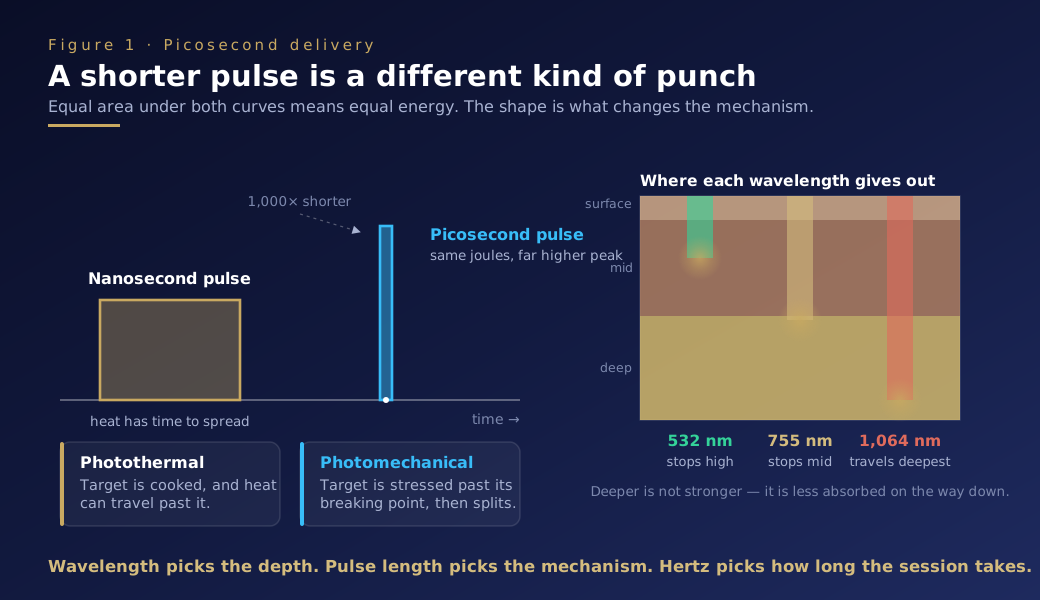
A melanosome — the packet of pigment a cell carries — dumps its heat to surrounding tissue in roughly a microsecond. A Q-switched pulse lasts around a hundred nanoseconds, already shorter than that, so the packet heats and shatters. A picosecond pulse lasts a few hundred picoseconds, another order of magnitude shorter. Energy arrives so fast that the target has no time to warm its neighbours at all; instead a pressure wave forms across it and it is fragmented rather than cooked. That is the photomechanical effect, and it is why "pico" machines are sold on coldness rather than on heat.
Pulse duration buys you the mechanism. Wavelength decides where the mechanism is triggered. On a triple-wavelength platform like the Golden Fano Pico, you are choosing between three different answers every time you change the tip.
The Absorption Rule, in One Line
Melanin absorbs short wavelengths far more strongly than long ones. That single fact sorts all three: 532 nm is grabbed hardest by melanin, 755 nm moderately, 1064 nm least. And the wavelength that is grabbed hardest by the epidermis is the one that travels least far into the dermis.
| Wavelength | Colour of the beam | Melanin absorption | Travels to | Also absorbed by |
|---|---|---|---|---|
| 532 nm | Green | Highest | Superficial — mostly within the epidermis and upper dermis | Oxyhaemoglobin strongly, which is why green light is the vascular-facing choice |
| 755 nm | Deep red, barely visible | Intermediate | Mid-dermis | A compromise band: still melanin-seeking, still penetrating |
| 1064 nm | Near-infrared, invisible | Lowest | Deepest of the three, because weak absorption and less scattering let it pass through the epidermis | Water marginally; largely a depth play |
Read the table as a lever, not a ranking. Push toward 532 and you get strong uptake at the surface, which is exactly what a superficial target needs — and the highest epidermal heat load of the three. Push toward 1064 and the beam walks through the epidermis nearly unbothered and releases its energy deep, where a dermal target sits.
Why Tattoo Ink Complicates the Choice
Pigment in the skin is not one chromophore. Tattoo inks are industrial pigments, each with its own absorption band, which is why a single wavelength genuinely cannot cover a multicolour tattoo:
- Black and dark grey absorb broadly, so 1064 nm handles them and is the safe default.
- Blue and green absorb in the red end of the spectrum, which is where 755 nm lives.
- Red, orange and some yellows absorb green light — that is 532 nm, and it is the reason the third handpiece exists rather than being a marketing accessory.
- Any colour that reflects the wavelength aimed at it is, from the laser's point of view, transparent.
That last line is the one to remember when a supplier shows you one tattoo faded and the next untouched on the same machine.
What the Honeycomb Lens Actually Changes
Energy in joules is only half the story; the tip optics decide whether that energy arrives as a sheet or as a field of pinpoints. The Golden Fano Pico ships with a fractional honeycomb array in the 1064 nm path.
The array is a plate of microscopic lenses. Each one takes a fraction of the beam and focuses it to its own tiny high-fluence point. Total energy is unchanged, but it is now distributed across dozens of columns that each exceed the threshold for optical breakdown in the dermis while the skin between them receives almost nothing. At those points the pulse ionises tissue fluid into a micro-plasma bubble — laser-induced optical breakdown, or LIOB — and the bubble's collapse is the mechanical insult.
The consequence for a clinic is concrete: the epidermis is not wounded, so there is no crusting surface to heal, and the stimulus lands in the dermis where the structural proteins are. This is the same "treat a fraction, spare the rest" logic a fractional ablative laser uses with tissue removal instead of pressure — see how fractional CO2 laser works.
Carbon Peel: The Laser Is Aimed at the Lotion
Every pico platform sells a carbon peel, and almost nobody explains the mechanism to the client. You coat the skin with a carbon lotion, let it dry into a film that settles into the surface texture, then pass 1064 nm over it. Carbon absorbs near-infrared extremely well and skin, at that wavelength, does not. So the pulse energy goes into the film, the film heats and detonates at a microscopic scale, and the expanding gas lifts the carbon off with whatever was sitting in the texture on it.
Two practical readouts from that physics. First, the laser never targets the skin in this protocol — the lotion is the chromophore, which is why a carbon peel is the gentlest thing the machine does and why it is used as a first appointment to introduce a client to a picosecond platform. Second, lotion quality and film thickness are variables in the treatment, not cosmetics: an uneven film is an uneven treatment.
Repetition Rate Is Not Power
Hertz is how many pulses leave the source each second. It does not raise the energy of any single pulse — that is set in millijoules or joules and stated as fluence at the tip. What raising the Hz actually does is shorten the gap between insults, so heat that had no time to accumulate at 1 Hz does accumulate at 10 Hz.
This matters for the spec sheet you are being quoted. Some platforms state peak energy and maximum repetition rate as though they coexist. Ask for the energy at the repetition rate you will treat at. A head that delivers 1600 mJ at 1 Hz and 300 mJ at 10 Hz is a different commercial product from one that holds energy across the range.
The Safety Item Nobody Puts in the Quote
Ophthalmic protection is wavelength-specific. Goggles rated for 1064 nm are not automatically adequate at 532 nm, and a green beam at high fluence is a serious retinal hazard long before it feels painful. Three things to confirm before a machine ships:
- Optical density marked per wavelength on the eyewear, matching every handpiece the clinic will use.
- Interlocks on the arm or tip that prevent firing away from tissue, and a key switch the operator can hand over.
- Emitted-light warnings and a beam-path explanation for treatment-room bystanders, since the 1064 nm beam is invisible.
Frequently Asked Questions
What is the difference between 1064 nm, 755 nm and 532 nm on a picosecond laser?
Melanin absorbs short wavelengths far more strongly than long ones. 532 nm green light is taken up hardest and stays superficial, and it is also the band oxyhaemoglobin absorbs. 755 nm deep red is the intermediate choice. 1064 nm near-infrared is barely absorbed by melanin, so it passes through the epidermis and releases its energy deepest of the three.
Why does a picosecond laser need three wavelengths instead of one strong one?
Because targets have different absorption bands. Epidermal pigment, dermal pigment and industrial tattoo inks are not the same material. Black ink absorbs broadly so 1064 nm handles it, blue and green inks absorb around 755 nm, and red inks absorb green light at 532 nm. A colour that reflects the wavelength aimed at it is transparent to that laser.
What does a honeycomb or fractional lens do on a picosecond handpiece?
It is a plate of microscopic lenses that splits the beam and focuses each fragment to its own tiny high-fluence point. Total energy is unchanged, but it arrives as many columns that exceed the optical-breakdown threshold in the dermis while the skin between them gets almost nothing. The epidermis is not wounded, so there is no crusting surface to heal.
Does higher Hz mean a more powerful laser?
No. Hertz is pulses per second; it does not raise the energy of any individual pulse. What a higher repetition rate does is shorten the gap between pulses so heat accumulates in tissue that would otherwise have cooled. Ask suppliers for the energy delivered at the repetition rate you intend to treat at, not the two maxima printed separately.
What is actually happening during a carbon peel?
A dried carbon film absorbs the 1064 nm energy; skin at that wavelength largely does not. The film heats and fragments at a microscopic scale and the expanding gas lifts it off the skin, taking the surface debris sitting in the film with it. The laser targets the lotion, not the skin, which is why the protocol is the gentlest thing these platforms do.
The Spec Sheet to Demand Before You Compare Two Picosecond Quotes
- Pulse width in picoseconds for each wavelength, and whether the machine is a true pico or a Q-switched source with a shortened tail.
- Single-pulse energy at the tip in mJ or J, per wavelength — not output at the laser bar.
- Energy held at your working repetition rate, which is the number that survives a real session.
- Spot size range in millimetres, since fluence changes with it at fixed energy.
- Which handpieces carry which wavelengths, and whether a tip does 1064 and 532 or only one.
- LIOB or fractional lens options, their microlens count and whether they are consumable.
- Wavelength-marked eyewear optical density, interlocks, key switch and beam-path documentation.
- CE technical file for the exact model, plus the service interval on the laser source itself — a pico bar is a wear item.