Ablative means tissue is removed, not heated. Fractional means only a grid of it is. Those two words carry the whole conversation about downtime.
In the resurfacing aisle, downtime is not a quality you negotiate with a supplier. It is an output of two machine settings — how deep each column goes, and how many columns you put per square centimetre. Everything a client experiences in the following fortnight is decided before the first pulse fires.
Here is the tissue physics behind that, and the parameter sheet that lets you read a CO2 quote properly.
Water Is the Target, and It Is Everywhere
The argument of selective photothermolysis is that you pick a wavelength the target absorbs and the surroundings do not. A CO2 laser at 10,600 nm inverts that logic completely, because its chromophore is water — and water is every cell in the field of view. There is nothing to be selective between.
Strong absorption has an immediate geometric consequence: the beam cannot travel. Energy is dumped within micrometres of where it lands, and it is dumped so densely that intracellular water flashes. The tissue is not denatured in place, it is physically removed. That is ablation, and it is why a CO2 handpiece is a cutting instrument in one mode and a resurfacing instrument in another while the laser source never changes.
Compare against the wavelengths we have covered elsewhere on this blog: an 808 nm diode looks for melanin and travels millimetres; a 1064 nm picosecond beam walks through the epidermis almost unabsorbed; a CO2 beam gives up its entire energy in the first thin layer it touches. Absorption and penetration are two sides of one curve, and the strongest absorber is the shallowest worker.
Why Fully Ablative Skin Took Months
Classically, resurfacing meant removing the whole epidermis and a measured slice of the dermis in one pass, over the entire treatment area. Uniform, and slow. The skin has to rebuild from its reservoirs — the deeper follicular structures and the wound edges — and when you have stripped the entire surface, the distance any cell has to migrate is the width of the whole face. That is the wound that took weeks to close and months to settle, with the pigment and texture consequences that came with it.
Fractional delivery does not make the injury gentler per column. It makes the injury smaller in aggregate.
Microthermal Treatment Zones: The Grid
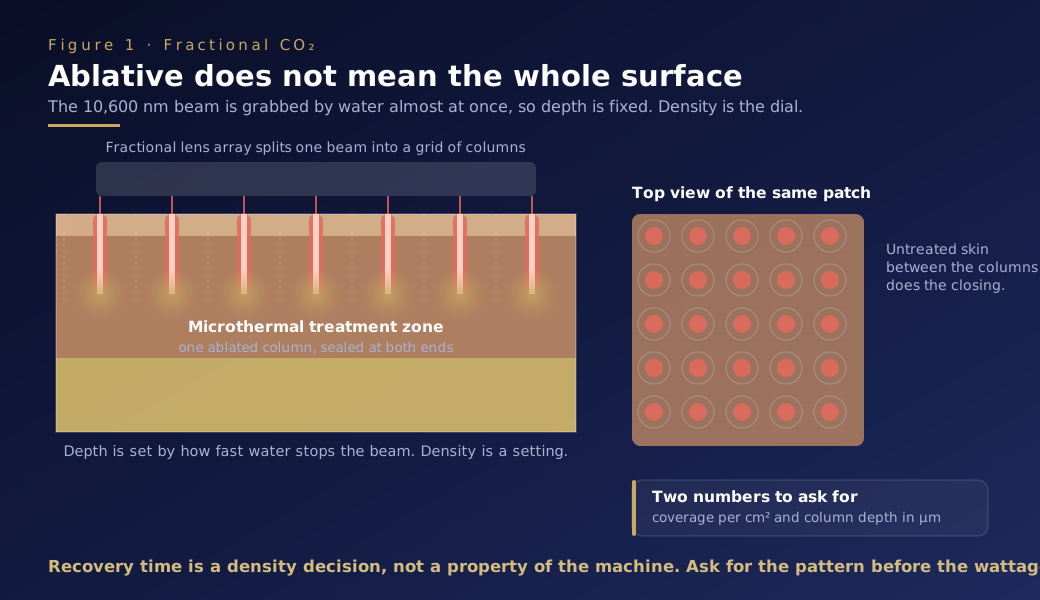
The handpiece scans the beam so that it lands as a regular array of vertical columns rather than a sheet. Each column is a microthermal treatment zone — an ablated channel through the epidermis into the dermis, walls coagulated by the same pulse that carved them. Between the columns, the skin is completely untouched.
The spared tissue is not an oversight; it is the mechanism. Three things it does:
- It is the cell source. Keratinocytes migrate out of every intact column toward the wounded ones, so the distance to cover shrinks from the width of a face to the spacing between dots. Migration is measured in millimetres a day, which is the arithmetic behind why a fractional wound closes in days and a confluent one in weeks.
- It keeps the barrier working. An intact network between columns means less fluid loss, less protein loss and a much smaller open wound for bacteria to colonise than a fully stripped surface.
- It leaves the dermal scaffolding partly standing. Coagulated columns stimulate new matrix; the bridges between them hold the architecture while that happens.
The same spare-the-neighbourhood logic reappears in the picosecond honeycomb lens, where the columns are pressure points rather than ablated channels — see RF microneedling for the third version of the idea, where the needle is the column.
Four Knobs That Set the Downtime
None is a "strength" control, and a supplier who quotes you one does not know the machine. What actually shapes the wound:
| Parameter | What it controls | What raising it costs you |
|---|---|---|
| Energy per microthermal zone (mJ) | How deep and how wide each individual column goes | Deeper coagulation, longer to re-surface from that hole, more oozing at the high end |
| Density — the share of the surface columnated in one pass | How many columns per square centimetre | Shortens the migration distance, until the spared bridges are too thin to function as a reservoir. Density has a ceiling for the same reason energy does |
| Passes over the same area | Multiplies both of the above | The most common cause of an over-treated zone, because nothing on the skin tells you it has been hit twice |
| Pulse structure and beam delivery | Whether energy arrives as one hit or sub-pulses, and how the scan pattern lays the grid | Uneven scan geometry means patchy results; a bad pattern is invisible in the first week |
Ask for the depth-versus-energy chart for the handpiece you are being quoted — a micron figure per mJ setting. Without it, your clinic is choosing a wound depth blind, and every aftercare conversation becomes a guess.
What the Client Sees, Day by Day
The generic version of this timeline lives in what happens to skin after an energy treatment. Ablative fractional has its own signature, and it is the one that surprises clients most because the face looks worse before it looks like anything.
| Window | In the tissue | In the mirror |
|---|---|---|
| During | Columns ablating; surrounding dermal collagen contracting from the heat | Prickling and a hot, tight sensation; smoke from the handpiece, which must be evacuated |
| First hours | Immediate inflammatory cascade; the treated area weeps serum at higher settings | Bright red, swollen, warm — a sunburn feeling with a distinct texture under the fingers |
| Days 1 – 3 | Crusts forming at every column; migration under way from the spared bridges | The dot grid is often visible on the skin, a bronze-bruish pattern. Skin feels like sandpaper. This is the single most important thing to warn about before the appointment |
| Days 4 – 7 | Re-epithelialisation completing across the treated zone | Flaking and peeling in a fine, rough pattern. Pink new surface underneath. Makeup only once the barrier has closed, and only with clean tools |
| Weeks 2 – 4 | Dermal matrix being laid down; vascular response still winding down | Pinkness that outlasts the flaking by a surprising margin. Clients with events on the calendar must be told this window exists |
| Months 2 – 6 | Remodelling and cross-linking of the new collagen | Where texture change actually appears, well after the surface has finished looking injured |
Dual-Mode Machines and Why the Second Protocol Is Separate
The Koli CO2 Laser is a dual-mode platform — one handpiece configuration for facial resurfacing, another for intimate-area work, and the intimate care category sits in the same family. Buyers often treat "dual mode" as two buttons on one machine. It is closer to two clinics in one cabinet:
- Tip geometry and parameter set differ, because the tissue differs. Mucosal and vulval tissue is thinner, better perfused, holds water differently and behaves very differently under the same fluence than facial skin does.
- Single-use applicators stop being a preference. A tip that crosses between patients and between anatomical sites is an infection-control question, and the answer must be consumables, not disinfection.
- Consent and screening are separate documents. The intake that covers a face does not cover an intimate area, and the operator training does not transfer automatically.
- Nothing about the second protocol should be improvised from the settings used on skin. Ask the factory for the parameter range per mode and refuse a machine that lets the two share one preset.
The Risks Are Setting-Driven
- Prolonged erythema — weeks of pinkness past the point the client expected to be finished.
- Pigment shift, in either direction. Skin with more epidermal melanin is less forgiving of an aggressive density-and-energy combination, which is why conservative first passes exist. This is the same reasoning that pushes pigment work toward longer wavelengths elsewhere on the menu.
- Texture change from stacked passes or from an uneven scan pattern — a visible grid that was not the intention.
- Infection where aftercare failed, which on a fractional wound means occlusive emollient, no picking, and cleanliness — not actives reintroduced on day three.
- Ectropion at the lower lid when too aggressive a setting is used where skin is thin and anchored. A technique failure with a surgical consequence.
- Herpetic reactivation in any client with that history — an energy treatment at depth is a trigger, and prophylaxis is their physician's call, not the clinic's improvisation.
Every one of these is a parameter decision or a screening decision made before the first pulse. That is what makes CO2 the most spec-literate purchase in the resurfacing aisle.
What CE Cover on a CO2 Does Not Cover
The Koli CO2 Laser carries CE marking under the LVD and EMC Directives — the electrical safety and electromagnetic-compatibility obligations for a machine of this class. That is not the same thing as a regulatory dossier for a medical indication, and clinics that intend to treat anything beyond cosmetic resurfacing are responsible for their own registration in their own market. Ask us for the declarations and the wavelength documentation; do not ask us what to tell your patient, because that is a question for the regulator you answer to.
Laser Safety, Which on CO2 Is Different From Everything Else
At 10,600 nm, water absorbs the beam so completely that it cannot reach the retina. The injury site is the cornea and the lens instead, and the hazard scales with the diffuse reflections off the treated tissue — the plume and the wound surface both scatter. Two consequences for the room:
- Eye protection must be rated for 10,600 nm with the optical density marked, and it is not interchangeable with the goggles bought for a 1064 nm laser. Nobody in the room is exempt, including the client.
- Smoke evacuation is a workplace requirement, not a comfort accessory. Ablation converts tissue into an airborne plume; a fan is not extraction.
Frequently Asked Questions
What does the CO2 laser actually remove from the skin?
Tissue, outright. At 10,600 nm water absorbs the energy so strongly that the beam penetrates only micrometres and deposits all of its energy there, flashing intracellular water and physically ablating the column it hits. That is why CO2 is called an ablative wavelength, in contrast to an 808 nm diode or a 1064 nm picosecond beam that travels through tissue seeking a specific chromophore.
Why does a fractional laser leave gaps between the treated columns?
The untreated bridges are the healing mechanism. Keratinocytes migrate out of every intact column toward the wounded ones, so the distance any cell must travel shrinks from the width of a face to the spacing between dots. The spared tissue also keeps the barrier partly functional, reducing fluid loss and infection risk, and leaves dermal scaffolding standing while new matrix is laid down.
What sets the downtime on a fractional CO2 treatment?
Four things, all decided before treatment: energy per microthermal zone, which sets column depth; density, the share of the surface columnated in one pass; the number of passes over the same area, which multiplies both; and the pulse structure and scan geometry. Re-epithelialisation typically completes in about five to seven days, with pinkness that outlasts the flaking by weeks.
Why does the face look like a dot pattern for several days?
Because the crusts form at every microthermal column and the grid is literally written on the skin. Add swelling and a sandpaper texture in the first three days, then fine flaking through day seven. This is the expected course, and it is the reason the pre-treatment conversation matters more on CO2 than on any non-ablative device.
Do CO2 laser safety goggles differ from those for other lasers?
Yes, and the difference is the direction of the hazard. At 10,600 nm water in the eye absorbs the beam so completely that it cannot reach the retina; the risk is to the cornea and lens, and diffuse reflections from the wound and the plume matter. Eyewear must be marked with an optical density at 10,600 nm and is not interchangeable with goggles bought for a 1064 nm picosecond laser.
The CO2 Specification Sheet to Demand, Column by Column
- Energy per microthermal zone in mJ, and the depth chart in microns that goes with it. Refuse a quote without the second.
- Selectable density settings and the actual dot geometry at each, in dots per square centimetre.
- Scan area of the handpiece in centimetres, which sets how long a full face takes and how repeatable the pattern is.
- Pulse structure: continuous, single pulse or sub-pulsed, and whether the coagulation and ablation phases are separable.
- Second-mode configuration: tip geometry, whether presets are genuinely isolated from the skin mode, and what the single-use applicator costs per case.
- Smoke evacuation requirement and whether it is supplied, included or an afterthought.
- Laser safety class and 10,600 nm-rated eyewear optical density, for operator and client.
- Which CE directives the marking actually covers — LVD and EMC are electrical obligations, not a medical-indication dossier, and your own market registration is yours to carry.