
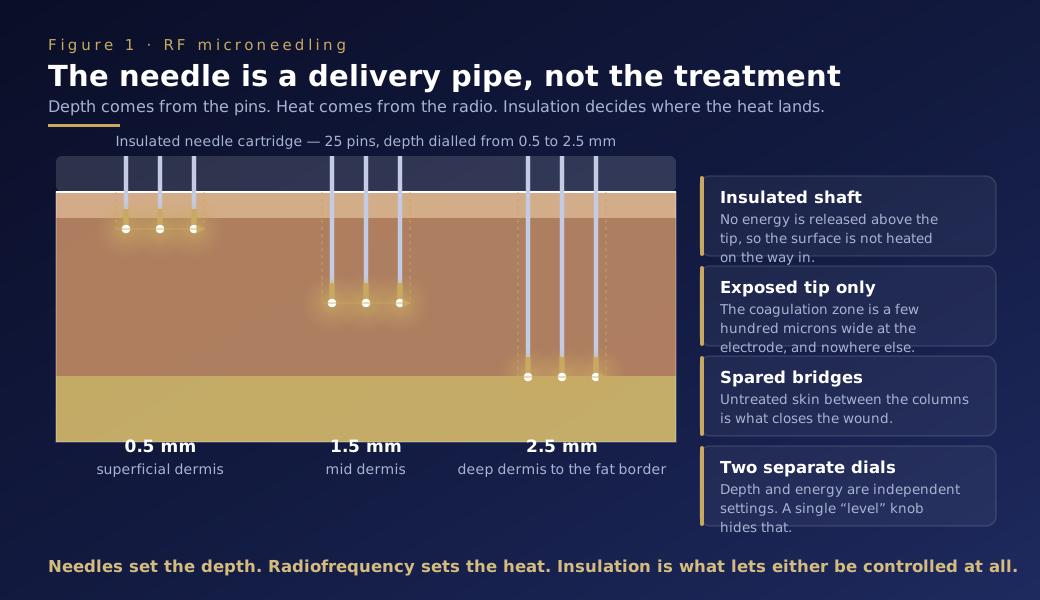
Two mechanisms share one handpiece. The needles decide where the energy lands; the radio frequency decides how much heat is deposited there.
Ask a room of clinic owners what RF microneedling is and you will get three different answers, because the name hides the trick. It is not microneedling with warmth, and it is not radio frequency with spikes. It is a delivery problem solved twice over: the needle gets the energy past the layer of skin that blocks it, and the radio frequency then does the work that heat can do.
Here is the physics, the layer model, the parameter set — and what the client feels the following week.
The Barrier That Makes Ordinary RF Shallow
Light-based devices hunt a chromophore — a molecule to absorb the energy. Radio frequency has no chromophore. It heats whatever resists the current, which means its behaviour is set by electrical resistance, not by colour. And the outermost layer of skin, the stratum corneum, is the most resistive tissue the current meets. That is the whole problem with surface RF: the resistance is highest exactly where you do not want the heat, and the current spreads across the surface on its way in.
An RF microneedling handpiece bypasses that. Insulated needles pierce the stratum corneum and carry the electrode to a chosen depth. The epidermis is no longer in the electrical path, so the heating profile moves down into the dermis where the collagen actually is.
What Each Part of the Needle Is For
Read a handpiece datasheet for these four attributes and you can compare two machines that look identical:
- Insulated shaft, exposed tip. The coating stops current leaving the sides of the needle, so energy discharges only at the bare point. Heat concentrates in a small volume at a known depth, and the epidermis above it is largely passed through, not cooked. This is the configuration that makes deeper settings survivable for the surface.
- Non-insulated shaft. Current leaves along the whole length of the needle, so the wound is a column from surface to tip. More total thermal effect per puncture, more visible surface reaction, and much less forgiving on skin with high epidermal pigment. Older-generation design, still sold as new.
- Needle count per cartridge. Our RF-MTS cartridge runs 25 needles. That number, multiplied by the spacing between them, defines how much skin one stamp treats — and therefore how many passes a full face needs and how long the procedure takes.
- Depth adjustment range. On the Kolifu Antiaging RF-MTS that range is 0.5 mm to 2.5 mm, adjustable. The increments matter as much as the endpoints: a dial that only moves in half-millimetre steps cannot follow the difference between a temple and a cheek.
The Layer Model: What 0.5, 1.5 and 2.5 mm Reach
Thickness figures below are textbook approximations for facial skin, not machine output — real skin varies by site, age and sex, and this is exactly why the depth dial exists.
| Needle depth | Roughly reaches | What the heat is doing there |
|---|---|---|
| 0.5 mm | Papillary dermis, just under the basement zone | Superficial texture and pore appearance; shortest recovery, least visible reaction |
| 1.0 – 1.5 mm | Reticular dermis, the collagen-rich middle | The standard working depth for firming and tone; collagen and elastin fibres live here |
| 2.0 – 2.5 mm | Deep reticular dermis down toward the septa | Structural tightening; longest recovery and the settings that demand the most conservative energy |
The same depth on a neck is not the same depth on a cheek. Subcutis thickness and dermal thickness differ by site, so a competent operator treats the face as a topographic map rather than one number.
Frequency, Duty and the Two Moments of Heat
Our platform runs RF at 2 MHz. Frequency in this range is a compromise: low enough that current flows readily through tissue, high enough that nerve and muscle are not stimulated into contracting. Below roughly 50 kHz the client feels the current as muscle twitch; at megahertz frequencies the sensation is heat only.
Two settings on the spec sheet decide the thermal dose more than frequency does, and suppliers rarely print both:
- Energy per pulse, and whether the RF emits on entry, on dwell, or on retraction. Each of those produces a different heat shape — a point at the tip, a short column, or a swept trail.
- Repetition rate and total pulse count per pass. This is where "same setting, longer session" turns into real accumulated heat. A handpiece that keeps firing while stationary will over-treat one spot.
Plain Microneedling Is Still a Different Machine
A microneedling pen such as the SKIN SURE MTS works at 0.25 mm to 2.0 mm with no energy at all. Its entire effect is the wound — the mechanical injury and the healing cascade that follows. It is cheaper, shallower-risk and has no thermal dimension to learn. The MTS collagen gun sits in the same family.
| Microneedling pen | RF microneedling | |
|---|---|---|
| Mechanism | Mechanical injury only | Mechanical injury plus thermal coagulation at depth |
| Depth ceiling (typical) | 2.0 mm | 2.5 mm, with energy delivered at that depth |
| Energy to buy | None — no RF generator, no thermal calibration | RF source, cartridge and handpiece all couple to the result |
| Visible reaction afterwards | Redness, tightness, mild swelling | Redness plus a bumpier, sunburn-like response that lasts a day or two longer |
| Consumable economics | Cartridge only | Cartridge only, but the cartridge is also the electrode — tolerance and insulation integrity become service items |
What the Client Sees, Day by Day
This is the conversation that prevents a five-month-old complaint. Full context is in our timeline of skin after an energy treatment; the RF-microneedling-specific version is below.
| Window | What is happening in the tissue | What the client sees |
|---|---|---|
| 0 – 2 hours | Perfused, inflamed; histamine released along the puncture tracks | Bright red, warm to the touch, mildly raised — a sunburn look with a dotted pattern |
| 24 – 48 hours | Peak inflammatory signalling; oedema settling | Redness fading to pink. Small firm bumps at puncture sites are common and are the expected response, not an allergy |
| Days 3 – 5 | Proliferative phase begins; surface keratinocytes migrating | Rough, dry, fine flaking. Tiny scabs where the needles entered. No picking |
| Weeks 2 – 4 | New matrix being laid down in the dermis | Skin looks calm. Texture changes begin to read in daylight |
| Months 2 – 3 and beyond | Remodelling: the fresh matrix is reorganised and cross-linked | Where firming is going to show up, if it shows up — this is the phase clients are most often told about too early |
The Risks That Are Real
None of these are exotic, and every one of them is a parameter or a screening problem rather than a device fault:
- Stacking passes. Going over the same zone twice at depth doubles the thermal dose. The handpiece gives no feedback that this happened.
- Too deep for the site. Temples, neck and any thin-skin area are where a cheek setting does damage.
- Pigment response. On skin with more epidermal melanin, any inflammatory insult can shift colour. Longer wavelengths and cooler surfaces are the standard mitigations — this is the reason insulated tips exist.
- Topical actives too soon. The channels are closed within hours, but the barrier is not restored for days. Acids and retinoids into a healing dermis is a self-inflicted burn.
- Reused cartridges. Needles blunt and insulation cracks. A bent needle tears rather than pierces, and a cracked coating turns an insulated tip into a non-insulated one.
- Unscreened healing history. Any client with a personal history of abnormal scarring, active skin infection on the face, or metal and electronic implants in the treatment path is a referral conversation, not a booking.
The Questions to Ask an RF-Microneedling Supplier
Copy this list into an email. A trader who cannot answer it is reselling someone else's machine.
- Insulated or non-insulated tips, and can they show the coating under magnification?
- Needle count, needle gauge, needle material, and the spacing between needles.
- Depth range and the adjustment increment.
- RF frequency in MHz, energy per pulse in joules or millijoules, and pulse duration in milliseconds.
- Does the RF fire on entry, on dwell, or on retraction — and is that selectable?
- Whether the handpiece has a temperature or impedance check that stops firing on poor contact.
- Cartridge price, how many faces one cartridge is rated for, and its shelf life sealed.
- What CE documentation exists — for this platform, radio frequency sources are assessed under the LVD and EMC Directives, so ask for the declarations, not a photo of a certificate.
Frequently Asked Questions
What does the needle actually do that RF alone cannot?
The stratum corneum — the outermost layer of skin — is the most electrically resistive tissue an RF current meets, so surface RF heats the surface on its way in. Insulated needles carry the electrode past that layer and discharge the energy at a chosen depth in the dermis instead.
What is the difference between insulated and non-insulated RF microneedling tips?
On a non-insulated needle the current leaves along the whole shaft, so the thermal column runs from the skin surface down to the tip. On an insulated needle the shaft is coated and only the bare point emits energy, concentrating the heat at depth and largely sparing the epidermis. Insulated tips are what make deeper settings workable on pigmented skin.
How deep does RF microneedling go?
On the Kolifu Antiaging RF-MTS the needle depth is adjustable from 0.5 mm to 2.5 mm. Roughly, 0.5 mm reaches the papillary dermis, 1.0 to 1.5 mm the collagen-rich reticular dermis, and 2.0 to 2.5 mm the deep dermis toward the septa. Facial skin thickness varies widely by site, which is why the dial exists and why one setting does not suit a whole face.
How long is the recovery after RF microneedling?
Expect bright redness and warmth for the first few hours, pink tone and small firm bumps at the puncture sites for a day or two, then dryness and fine flaking through days three to five. Most clients are presentable under coverage by the end of the first week. The dermal remodelling phase runs for months after that.
Is RF microneedling the same as a microneedling pen?
No. A microneedling pen creates micro-injuries mechanically and adds no energy — the SKIN SURE MTS works from 0.25 mm to 2.0 mm with no thermal component at all. An RF microneedling platform adds a radio frequency source that fires through the needles, which brings a second variable, thermal dose, into both the result and the risk.
The Eight Numbers to Collect Before You Compare Two RF Microneedling Quotes
- RF frequency in MHz, and pulse energy and duration alongside it — frequency alone tells you nothing.
- Needle count and gauge, plus the spacing, because the three together set treatment time per pass.
- Insulated or non-insulated, in writing, with the coating method named.
- Depth range and adjustment increment, not just the endpoints.
- Firing mode: on entry, on dwell or on retraction — this is the heat shape.
- Contact or impedance detection, and what the machine does when the cartridge lifts.
- Cartridge cost per face and rated lifespan, since this is your real cost of service.
- CE documentation under LVD and EMC for the exact model number, not the factory in general.