
Whatever the brochure says, a light-based aesthetic machine only ever does one thing: it hands energy to a target, and the target turns that energy into heat. That single sentence explains why one handpiece clears sun-freckled tone while another leaves a burn on the same patient. The term for it is selective photothermolysis — photo (light), thermo (heat), lysis (destruction) — and it is not a brand, a technology or a marketing word. It is the design rule every laser and intense-pulsed-light device obeys, including the ones on your treatment-room shelf. Learn the four variables and you can read any supplier specification sheet in about ninety seconds.
The Target Is Called a Chromophore
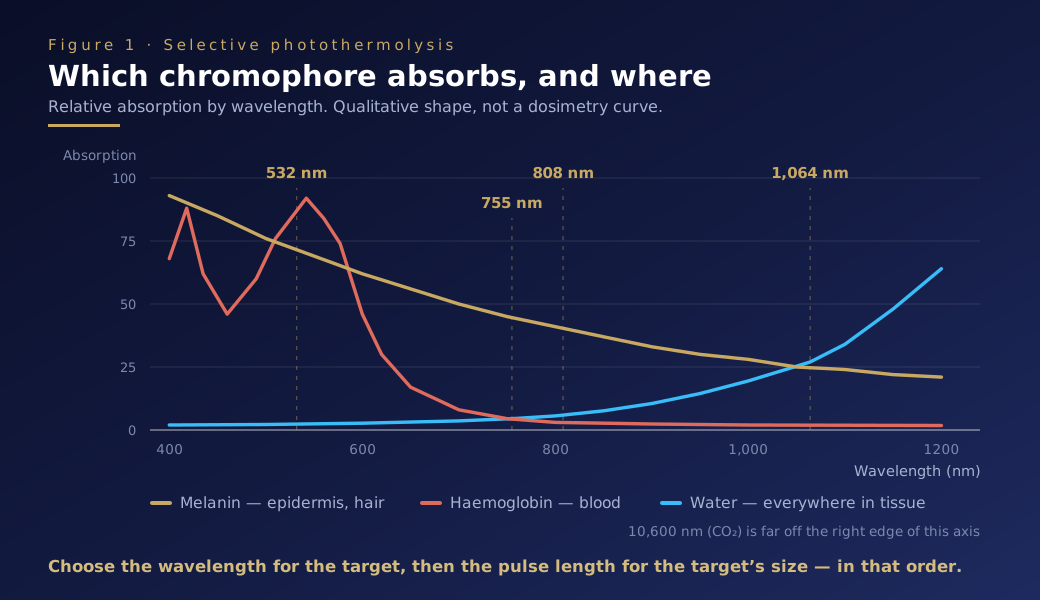
Skin is not one uniform material. It contains a small number of chromophores — molecules that absorb light at particular wavelengths. Three matter in aesthetic work:
- Melanin, the pigment in the epidermis and in hair follicles. Absorbs broadly across the visible spectrum, more strongly at shorter wavelengths.
- Haemoglobin, in blood. Absorbs in visible bands and is why vascular-looking tone responds to greener-yellow wavelengths.
- Water, everywhere in tissue. Absorbs weakly in the visible and strongly in the infrared — which is why some wavelengths cut tissue and others merely warm it.
The chromophore you aim at decides the wavelength you need. Aim at melanin and you pick a wavelength melanin drinks up while the tissue around it stays relatively transparent. Aim at water and you move far into the infrared, where essentially all the energy stops in the top fraction of a millimetre.
Pulse Duration: The Clock Nobody Mentions
This is the variable that separates a competent operator from a lucky one, and it is almost absent from supplier marketing. Every structure has a thermal relaxation time — roughly how long it takes to shed half its accumulated heat into its surroundings. Small structures dump heat quickly; large ones slowly.
The rule: if your pulse is shorter than that structure's relaxation time, the heat stays contained in the target and does the work there. If your pulse is longer, heat conducts outward into surrounding tissue on the way in — and that is what a burn is. Same wavelength, same energy, completely different outcome.
Pulse length is also why two machines rated at the same joules behave nothing alike. A millisecond-scale pulse and a nanosecond-scale pulse are not different amounts of the same thing; they are different physics.
Fluence and Spot Size Travel Together
Fluence is energy per unit area, usually written in J/cm². Ask any supplier for the fluence at the tip of the handpiece, not the output at the source — the number you care about is what arrives at skin.
| Variable | What it controls | What to ask the supplier |
|---|---|---|
| Wavelength | Which chromophore absorbs | Nm at the tip, and the absorption logic behind it |
| Pulse duration | Whether heat stays in the target | Range of settings, and the minimum |
| Fluence | How much energy per cm² | Measured at the handpiece, not the generator |
| Spot size | Depth of penetration and speed | Window dimensions in cm |
| Repetition rate | Session length and throughput | Hz at rated fluence, not at reduced fluence |
| Cooling | Epidermal protection and comfort | Contact, air or cryogen — and what it costs per year |
Spot size does double duty. A larger window lets light penetrate deeper — less of the beam is lost at the edges — and it covers more area per flash, which is why a body handpiece with a genuinely large spot finishes a leg in a fraction of the passes. Our 808nm diode laser is built around a 2 × 2 cm sapphire contact-cooled window precisely so that full-body work is a throughput job rather than an afternoon.
Cooling Is Half the Treatment
You want the deep target hot and the surface cool — the opposite of what heat naturally does. That is only possible if something removes epidermal heat faster than the pulse delivers it. Contact cooling through a sapphire tip does it during and immediately around each pulse; forced air does it between pulses; cryogen is a different engineering trade-off again.
Cooling is also where safety and skin tone meet. Melanin in the epidermis competes for the same light as melanin in the target, so on deeper tones the surface has to be protected harder — which is a machine property, not a technique trick. Read how to choose a professional HIFU machine for the same question asked of ultrasound, where the equivalent issue is energy that leaks into layers you did not aim at.
Not Everything on Your Shelf Obeys This Rule
Two common categories break the frame entirely, and knowing that protects you from bad comparisons:
- Radiofrequency is electrical bulk heating, not light. There is no chromophore and no melanin competition, which is why RF is tone-indifferent by mechanism. See RF machines.
- Focused ultrasound is mechanical energy deposited at a geometric focal point, chosen by depth rather than by absorption. That is what makes the millimetre depths on a HIFU cartridge meaningful.
A machine that mixes modalities therefore mixes rules — and the honest ones will tell you which setting belongs to which physics.
Frequently Asked Questions
Does a higher-wattage machine always mean better results?
No. Wattage describes how much energy the source can produce, not what reaches your target. A powerful machine with the wrong wavelength for the chromophore, or a pulse longer than the structure can dispose of, wastes the power and raises the risk. Compare wavelength, pulse duration and fluence at the tip before you compare watts.
Why do the same settings behave differently on different skin tones?
Epidermal melanin absorbs the same light as the target below it, so on deeper tones more of the energy is intercepted before it arrives. Protecting the surface with contact or air cooling is what allows the deeper target to be reached safely; that is a property of the handpiece, not of operator skill alone.
Are RF and ultrasound also selective photothermolysis?
No. Neither is light. Radiofrequency heats tissue electrically in proportion to its impedance, and focused ultrasound deposits mechanical energy where the geometry focuses it. Both are tone-indifferent for a different reason than lasers are, so treat their specifications separately.
What is the minimum specification information a supplier should give?
Wavelength in nanometres, the available pulse duration range, fluence measured at the handpiece tip, spot or window size in centimetres, repetition rate at rated fluence, and the cooling method. If any of those six is missing, you are being asked to buy on adjectives.
A Ninety-Specification Read: What to Collect Before You Compare Quotes
- Wavelength, in nanometres. Then ask which chromophore it targets and whether that matches the service you want to sell.
- Pulse duration range, including the shortest setting — the floor matters more than the ceiling.
- Fluence at the tip, not output at the source, in J/cm².
- Window or spot size in centimetres, because it sets both penetration and how long a body session takes.
- Cooling method and its running cost, including consumables and any cartridge or tip that is a per-session expense.
- Repetition rate at rated fluence, since many machines only hit their headline hertz when dialled down.