
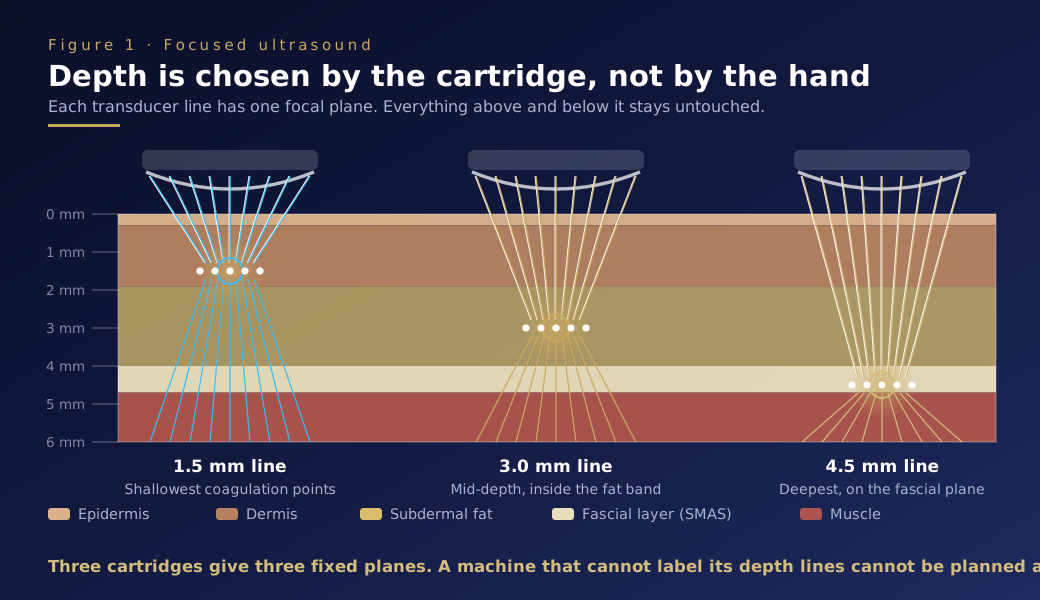
With focused ultrasound, depth is chosen by geometry, not by absorption — which is the single most useful thing to understand about the machine. Ask a supplier what makes one HIFU machine better than another and you will hear about joules, lines and comfort. None of that means much until you understand the one parameter that defines the category: where the energy stops. This post is a layer-by-layer reading of the cartridges on your shelf, so you can explain to a client — and to yourself — why three different depths exist and what each one is for.
Why Ultrasound Behaves Differently from Light
Light-based devices are selective because of chemistry: a chromophore absorbs a wavelength. Ultrasound has no chromophore. It is mechanical energy, and it goes where the transducer's focal geometry tells it to go. Change the curvature of the lens and the same frequency lands at a different depth.
Two consequences follow, and both matter commercially:
- It is tone-indifferent by mechanism. There is no melanin competing for the beam on the way down, so epidermal pigment is not the limiting factor the way it is for lasers.
- The cartridge is the treatment. Because depth is built into the consumable, the handpiece you fit determines what you can offer — which is why cartridge-based HIFU systems are sold as a menu of depths rather than a single setting.
The Three Depths, Layer by Layer
| Cartridge | Lands in | What lives there | What clients say they noticed |
|---|---|---|---|
| 1.5 mm | Superficial to mid dermis | Collagen and elastin fibres, skin quality machinery | Surface texture and finish; the least dramatic, most comfortable |
| 3.0 mm | Deep dermis and lower face | Thicker collagen network, the septal scaffolding | Firmness and bounce; the general-purpose depth |
| 4.5 mm | SMAS — the muscular-aponeurotic layer | The fibromuscular sheet that holds structure up | Contour and jawline; the one that reads as a lift in photographs |
The 4.5 mm cartridge is the one clinics build a price around, and the reason is anatomical. Below the dermis lies a continuous fibromuscular layer — the same sheet surgeons work with in a facelift. Thermal coagulation points placed inside it contract and then remodel, which changes the outline rather than only the surface. Superficial depths cannot do that, no matter how many lines you fire.
That is also why a menu with only 1.5 mm is not a budget version of the same treatment; it is a different treatment, doing a different job. Price it and sell it as such.
Lines, Dots and Pulse Width
Depth tells you where. The delivery pattern tells you what shape the energy makes there.
Older continuous-line transducers lay down a nearly unbroken burn, which is effective but uncomfortable and slow to settle. Newer machines alternate between a linear line for structural work and a dot pattern that leaves healthy tissue between coagulation points — the same fractional logic that makes resurfacing tolerable. Our dual-mode HIFU exists precisely so one handpiece can do the scaffold and the other the texture.
Pulse width is the third lever and the least advertised. Shorter, sharper delivery concentrates the mechanical effect at the focus and gives the surrounding tissue less time to conduct heat sideways — which is what the "100μs" figure on a platform like SYNCHROLIFT is really claiming. Treat such numbers as a design statement and verify them the only way that works: on your own clients, on your own pain scale.
What the Client Feels, and When
| Timeframe | What is happening | What to tell them |
|---|---|---|
| During | Discrete deep points of warmth as each line lands; a brief ache at 4.5 mm | Sensation means energy reached the layer, not that something is wrong |
| First hours | Mild pinkness, sometimes light swelling along the jaw | Surface reaction only; nothing structural yet |
| Days 2–7 | Skin settles; a few report tenderness when chewing or pressing | Normal, self-limiting, no downtime required |
| Weeks 2–8 | Collagen remodelling in earnest | This is where the change actually comes from — not the day of treatment |
| Months 3+ | Maturation and settling of the new structure | The fair moment to judge the result and photograph it |
The awkward truth of this category is that the visible payoff and the appointment are separated by two or three months. Clinics that explain the timetable at booking get far fewer "is it working?" calls in week three than clinics that sell the lift as an event.
Where HIFU Loses
Being honest about the limits is what makes the rest of the pitch credible. Ultrasound does essentially nothing for surface pigment or fine texture — those live in the layers light-based devices address. It also will not add volume where volume has been lost; deep structural work is not filling. And a very lax, thin-skinned patient is not the ideal case for any non-invasive contouring device, whatever a competitor implies.
For surface quality the answer is a different machine on the same floor. The comparison is set out in HIFU vs RF, and the brand-versus-technology question in HIFU vs Ultherapy.
Frequently Asked Questions
Which HIFU depth should a new clinic buy first?
Start with 4.5 mm and 3.0 mm if you are selling contouring, because that is where the visible structural change lives, and add 1.5 mm when your menu needs a texture service. A single-depth machine limits what you can promise, and depth is fixed in the cartridge rather than dialled on the console.
Does HIFU work on all skin tones?
Mechanically, yes — focused ultrasound is not absorbed by melanin, so the surface-pigment competition that constrains lasers does not apply the same way. That is a mechanism statement rather than a blanket safety claim: contraindications follow tissue state and anatomy, and you should confirm what your local rules allow you to advertise.
Why is 4.5mm the expensive setting?
Because at 4.5 mm the focus sits in the SMAS layer, the fibromuscular sheet that carries facial structure. Changes there read as contour in a photograph; changes at 1.5 mm read as finish. Clinics price the outcome the client can see from across the room.
How long after a HIFU session should a client wait before judging it?
Judge at three months, not two weeks. The appointment delivers thermal points; the change comes from the remodelling that follows, and that process runs for months after the last line is fired.
Before You Buy: Six Questions That Separate Real Depth from Marketing Depth
- Which depths does the cartridge system actually offer, and is each one stocked at a price you can live with?
- Lines per cartridge and price per cartridge, divided to give your consumable cost per treatment. See the consumables guide.
- Is there a dot pattern as well as a linear one, or only continuous lines?
- What the pulse width claim means in practice, verified on real clients rather than on the spec sheet.
- How many lines a full face-and-neck protocol consumes, because that number sets your margin.
- Training and a named support contact, since depth selection is a technique decision, not a dial.