

Short answer: score the machine, not the sales conversation. Equipment purchases go wrong because buyers evaluate the demo, the photographs and the quoted price, and never write down the things that decide the outcome over five years: documentation, consumable dependence, service access and whether the device fits the menu you already sell. A scorecard fixes that, because it forces the same questions on every quote you receive — which is also the only way to compare two machines that are not the same machine.
Why Weighting Matters More Than the Questions
Most buying checklists fail because every line feels equally important while you are reading it, and then the demo dominates. Weighting is how you decide the trade-off in advance, sober, instead of in the room with a coffee and a brochure.
Two structural rules do most of the work:
- A one-vote-veto category. Some failures are not offsettable. If the regulatory documentation cannot be verified, nothing else on the sheet matters — a cheap machine you cannot legally operate or insure is not a cheap machine.
- A floor, not just a winner. Decide before you start that a machine scoring below a set total goes no further, even if it is the only option you have found. The alternative is rationalising the first quote you received.
The Six Categories We Recommend
1. Documentation and regulatory evidence
What exists on paper about this specific unit: declaration of conformity, the directives or standards it is declared against, technical file availability, serial and model traceability, and whether the stated indications match what the supplier is actually telling you. Score on evidence you have seen, not on the supplier's assertion that it exists.
2. Total cost of ownership
Acquisition is one line out of five. Freight, duty and clearance, installation, operator training, consumables per treatment, and maintenance after the warranty period all belong in the number you compare. We walk through the arithmetic in our cost-of-ownership guide; for the scorecard, what matters is whether the supplier gave you enough to build that figure, or only a price.
3. Consumable independence
How much of your per-treatment cost is controlled by somebody else. Coded cartridges, timed activation, proprietary solutions and single-source tips all transfer pricing power to the supplier. A machine with a published shot count, an honest consumable list and no lock-out behaves very differently over five years from one without.
4. Fit to your existing menu
Does this device chain into services you already sell, or does it require you to build a client base from scratch to justify it? A machine that preps skin for an infusion service, or finishes a protocol you already run, earns its floor space. An isolated one has to carry its own marketing budget. Menu roles — entry, connector, anchor are the framework we use to answer this row.
5. Operator learning curve and safety controls
How much of the result depends on one experienced pair of hands. Look for parameter logic you can actually follow, real-time feedback on skin response, controlled cooling, temperature cut-off, and interlocks that prevent an applicator being fired outside its safe range. Consistency is a safety feature before it is a business one — and it determines whether your second therapist can deliver what your first one promised.
6. Service, spares and downtime
The question is not "is there a warranty" but "how many days is this machine unavailable when it fails, and who pays for that". Confirm: warranty length and what it excludes, parts availability window, whether a loan unit or remote diagnosis exists, response commitment, and whether a failed component is replaced or the whole applicator is sold to you again.
The Sheet
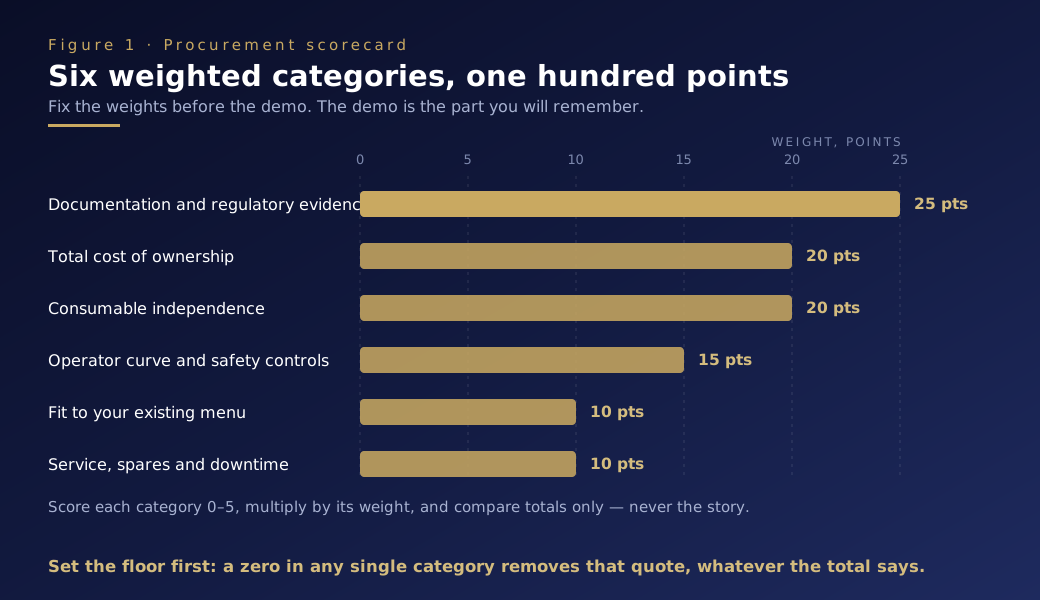
Score each line 0–5, multiply by the weight, and total it. Adjust the weights to your own situation — the point is that you adjust them before seeing the quotes, and apply the same sheet to all of them.
| Category | Weight | Score 0-5 | What a low score looks like |
|---|---|---|---|
| Documentation and regulatory evidence | 25 | ___ | Certificates described but not shown; model-level only, no unit traceability |
| Total cost of ownership | 20 | ___ | A price and nothing else; consumable cost unknown |
| Consumable independence | 20 | ___ | Coded or timed cartridges; no published life; forced proprietary solutions |
| Fit to existing menu | 10 | ___ | Requires an entirely new client segment to justify |
| Operator curve and safety controls | 15 | ___ | Outcome depends on one named therapist; no feedback or cut-off |
| Service, spares and downtime | 10 | ___ | No parts window stated; repairs mean shipping the machine abroad |
| Total | 100 | ___ | Set your floor before you start scoring |
Veto: score 0 in the documentation row and the machine is out regardless of total.
What to Do With the Result
Send your completed sheet back to each supplier and ask them to fill it in for their own machine. Two things happen. Useful suppliers correct the gaps — they send the document you could not find, or publish a shot count they had not volunteered. The others explain why the question does not matter, which is information too.
Keep the sheets. When you buy the second machine, your first purchase becomes the comparison, and the numbers you recorded are worth more than your memory of the demo.
Where This Gets Easier
Buying factory-direct removes several rows from the sheet by construction, because the party answering the questions is the party that built the machine. On our side of the counter that means: CE marking under the Low Voltage and EMC Directives with the declaration supplied alongside the unit; published cartridge life and handpiece specifications on every product page; a 36-month parts and labour warranty; 110V/220V, 50/60Hz configuration for the destination market; and a named technical contact rather than a general inbox. Our factory profile and OEM programme cover how units are built and tested before they ship.
If you want to see how a specific platform scores, take the catalogue apart with these six categories, or send us a competitor quote and we will tell you which rows we cannot fill in either.
Questions Worth Asking Verbally, Not on Paper
- Which of your clinics bought this model two years ago, and are they still treating with it?
- What is the most common failure on this platform, and what happens when it occurs?
- If I buy two units now, what changes in your support for me in year three?
- What would you not recommend this machine for?
That last one is the fastest competence test available. A manufacturer who builds honest equipment can always tell you where their machine is the wrong choice.
Frequently Asked Questions
What should I check before buying a professional aesthetic machine?
Six categories, weighted before you see any quote: regulatory documentation you have actually been shown, total cost of ownership rather than purchase price, consumable independence, fit to the menu you already sell, operator learning curve and safety controls, and service terms including parts availability and downtime. Score each and set a floor total below which no machine proceeds.
Which buying criterion is the most important?
Documentation, and it is the only one that should act as a veto rather than a score. A machine you cannot legally operate, insure or clear through customs is not cheap however low the price is, and no strength in the other five categories offsets an unverifiable certificate. Weight it highest and treat a zero in that row as disqualifying on its own.
Should I send my completed scorecard to suppliers?
Yes — it is the fastest way to separate useful suppliers from evasive ones. Good suppliers close the gaps: they send the document you could not find, or publish a shot count they had not volunteered. Others explain why the question does not matter, which is also an answer. Keep the completed sheets, because your next purchase needs a baseline that is not your memory of a demo.
How do I compare two machines that are completely different?
That is the reason the sheet exists. Apply identical weights and identical questions to both, and the comparison becomes about which one scores rather than which one demoed better. The method also exposes the trade-offs explicitly — a cheaper acquisition that scores poorly on consumables and service is a decision you can see in advance instead of discovering in year two.