The logo is the easy part. A factory can print your name on a housing, your colour on a bezel and your language on a touchscreen in a single production run, and every supplier quoting you will say yes to that within minutes. What almost nobody discusses in the first email is the question underneath it: once your brand is on the machine, which parts of the machine are actually yours — and what happens to your business if the relationship ends. Private label is a contract about ownership, not a decoration service. Below are the five ownership questions, the clauses that decide whether you are building an asset or a dependency, and a sequence that keeps you from paying for tooling you cannot move.
OEM, ODM and White Label Are Three Different Deals
These words get used interchangeably in quotations, and the difference changes what you are allowed to claim afterwards. Use them precisely in your own contract:
| Arrangement | Who designed it | What you can change | What you are really buying |
|---|---|---|---|
| White label | The factory, unchanged | Nameplate, packaging, manual cover, sometimes the boot screen | A resale identity on a product other buyers also sell |
| OEM | The factory's platform, built to your specification | Housing colour and finish, logo placement, UI language and presets, handpiece configuration, packaging | A differentiated product on a proven engineering base |
| ODM / your own design | You, or a design house you hired | Industrial design, moulds, electronics, firmware behaviour | An engineering programme — with the schedule and the risk that comes with one |
Most distributors and clinic groups who ask for "our own brand" want OEM, not ODM. That is the right instinct: you get a machine that looks and behaves like yours without funding the development of a new energy platform. Our OEM page describes the three levels we run — appearance customisation, function customisation, and building something new from your own concept — and the honest boundary is that each level costs more time and more commitment than the one before it.
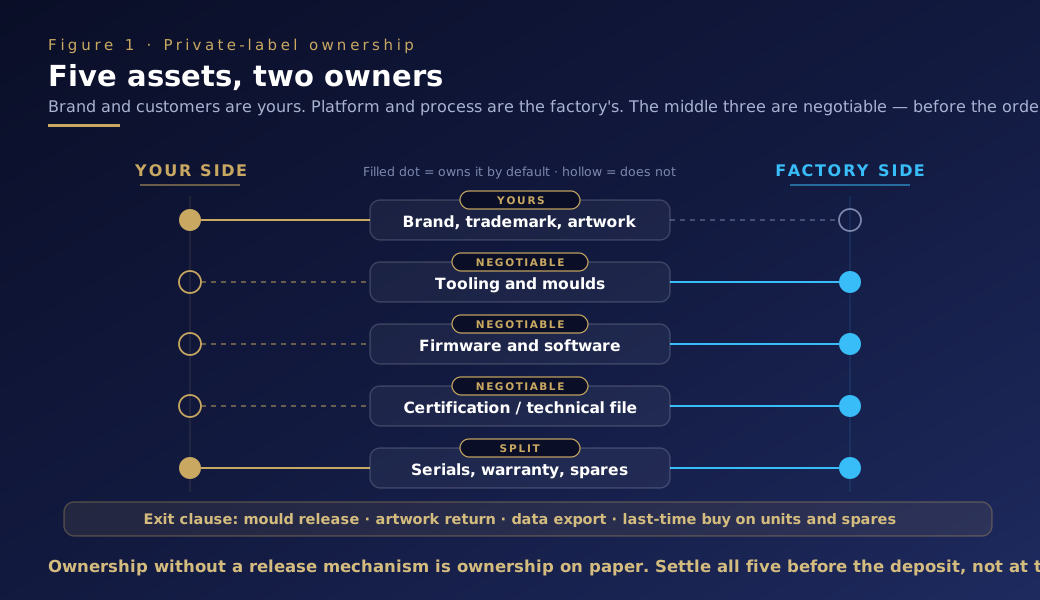
The Five Ownership Questions
Ask all five in writing before you pay a deposit. A supplier who answers them clearly is a supplier who has done this before; a supplier who answers only the first one is selling you a logo.
1. Brand and artwork
Your trademark, your logo files, your colour references, your packaging design. These should be yours outright, supplied by you, licensed to the factory for this production only, and returned or destroyed at the end of the relationship. Two practical details: give the factory vector artwork and a Pantone or RAL reference rather than a photograph of a printed box, and require a signed pre-production sample of the nameplate and the boot screen. Colour drift between a screen proof and an injection-moulded bezel is the most common cosmetic dispute in this business.
2. Tooling and moulds
If you pay for a mould, the contract must say who owns the steel, where it is stored, who may use it, and what it costs to release it. Ownership without a release mechanism is ownership on paper only. Ask specifically: may the factory run the same mould for another customer, and is that answer different if you paid the full tooling cost versus a share of it? A shared mould is a legitimate commercial arrangement — it lowers your entry cost — but you must know you are in one, because it means your "exclusive" housing is available to your competitors.
3. Firmware, software and the screen
This is the asset buyers most often forget. The treatment presets, the user interface, the language files and any cloud or app dependency are software, and software is licensed rather than sold. Establish four things: whether you receive a licence to use it or rights to modify it; whether the device needs a server the factory controls to operate or to update; who can push an update and whether you can refuse one; and what happens to the installed base if the factory stops supporting the platform. A device that stops working when a remote account lapses is not a private-label asset — it is a subscription you did not know you were signing.
4. Certification and the technical file
The declaration of conformity, the test reports and the technical file describe a product and name a responsible party. When your brand goes on the housing, your name may need to go on that paperwork too — and that is a change in legal position, not a printing decision. Settle before production: whose name appears as manufacturer on the declaration, whether the existing test reports cover your modified configuration or a new assessment is needed, who holds the technical file, and whether you can obtain a copy of it. The mechanics of the document pack itself are covered in the import compliance guide; the private-label addition is that a housing change, a power-supply change or a firmware change can invalidate a report that was perfectly valid for the base model.
5. Serial traceability, warranty and spares
Your brand means your customers call you. So you need the serial-number-to-order mapping, the warranty terms you are allowed to pass downstream, the spare-parts list with part numbers, and a stated supply commitment for consumables and wear items. Ask how long spares will remain available after the model is discontinued, and get the answer as a number of years in the contract. A private-label machine with no parts pipeline becomes unserviceable inventory the moment a handpiece window cracks.
The Clauses That Decide Asset Versus Dependency
Ownership questions tell you what you have. These clauses tell you what you have if the relationship sours — which is the only version of the question worth negotiating.
- Exclusivity, defined by territory and by scope. "Exclusive" can mean the housing design, the model name, the whole platform, or nothing more than a promise not to sell to your named competitors. Write down which, in which countries, for how long, and what minimum volume keeps it alive. An exclusivity clause with no volume condition and no expiry is a clause the factory will eventually renegotiate.
- Non-circumvention. If you introduce the factory to a market or a customer group, say what happens if they approach those customers directly. This is worth more to a distributor than a discount.
- Continuity and last-time buy. A defined notice period before discontinuation, plus the right to place a final order for units and spares. Without it, your installed base is stranded on the factory's product roadmap.
- Exit: tooling release, artwork return, data export. The three things you must be able to walk away with. If you cannot move the mould, recover your brand files and export your own device records, then leaving means starting again from zero — and the factory knows it.
- Change control. No substitution of components, power supplies, handpieces or firmware versions without written notice and your approval. Silent component substitution is how a certified product becomes an uncertified one while the housing still carries your logo.
What Changes in Your Own Obligations
Putting your name on a device moves you along the responsibility chain, and it is worth being clear-eyed about this before you commit. You become the party your customers, and in many markets your regulator, will address first. Practically that means: you need the manual in the language of the market where the machine operates, you need a complaint and incident record you can produce on request, you need to know which claims your marketing is allowed to make, and you need a service path that does not run through a factory's inbox on the other side of the world.
None of this is a reason to avoid private label. It is the reason to price it properly. The margin on a branded device has to fund training, documentation, spares holding and support — which is exactly the set of costs that total cost of ownership puts on the table and a unit price does not.
A Sequence That Keeps the Risk in Order
| Stage | What you produce | What you must not skip |
|---|---|---|
| 1. Specification | Target market, client mix, treatment menu, required wavelengths/depths, mains voltage and frequency, languages | Deciding the market before the machine — see reading a spec sheet |
| 2. Supplier due diligence | Factory audit, document pack review, sample unit evaluation | The checks in vetting a supplier — done before any tooling discussion |
| 3. Ownership terms | Signed answers to the five questions plus the exit clauses | Tooling ownership and release, firmware licence, name on the declaration |
| 4. Pre-production sample | One unit in your finish, your language, your presets | Approving the nameplate, boot screen, manual and packaging together, not separately |
| 5. Compliance confirmation | Declaration and reports matching the approved configuration | Checking the model code on the paperwork is the modified model, not the base model |
| 6. Production and crating | Serial list mapped to your order, packing list, invoice, HS code | Serial-to-paperwork traceability before the crate closes |
| 7. Launch and support | Operator training, aftercare sheets, spares kit, complaint log | A service path you control, not one you forward |
The ordering matters more than the content. Stages two and three are cheap to do and expensive to redo: once tooling is cut and a production slot is booked, every ownership question you forgot becomes a renegotiation from a weak position.
Cost Lines That Only Appear in Private Label
A white-label purchase and a private-label programme do not have the same cost structure, and the difference is not the unit price. Expect to fund: artwork and packaging design; pre-production samples and the courier round-trips they generate; tooling, if the housing is genuinely yours; a compliance review or new testing where your configuration differs from the certified base; translation of the manual and the interface; a spares holding sized to your installed base rather than to one machine; and the staff time to run a complaint log and a training programme. Put these against the volume you realistically expect in the first year, not the volume in the supplier's minimum-order conversation. We discuss order quantities and lead times per project rather than publishing a single number, because the honest answer depends on which of the three OEM levels you are actually asking for.
Frequently Asked Questions
What is the difference between OEM and ODM for aesthetic equipment?
OEM means the factory builds its existing platform to your specification — your housing finish, logo, interface language, presets and packaging. ODM, in the sense most buyers mean it, means the design originates with you and the factory manufactures it, which adds industrial design, moulds and an engineering schedule. If you want a differentiated product without funding new platform development, OEM is the arrangement to ask for.
If I pay for the mould, do I own it?
Only if the contract says so, and only if it also says how you get it back. Specify ownership of the steel, its storage location, whether the factory may run it for other customers, and the cost and notice period to release it to another manufacturer. Paying the tooling invoice without a release clause gives you a financial contribution, not a movable asset.
Does putting my brand on a device change who is responsible for certification?
It can. The declaration of conformity names a responsible party, and a housing, power-supply or firmware change may mean the existing test reports no longer describe the product you are selling. Settle whose name appears as manufacturer, who holds the technical file, and whether your configuration needs a fresh assessment — before production, not at the border.
Can a private-label device depend on the factory's cloud or app?
It can, and that dependency is a commercial risk you should price. Ask whether the machine operates fully offline, who can push firmware updates, whether you can decline one, and what happens to units already in the field if the platform is discontinued. A device that needs a remote account to function is not an asset you control.
Before You Commit: The Short Version
- Name the arrangement — white label, OEM or your own design — in the contract, not just in the email thread.
- Get written answers to the five ownership questions, with tooling release and firmware licence spelled out.
- Define exclusivity by territory, scope, duration and volume, or accept that you do not have it.
- Confirm the compliance paperwork matches your modified configuration and carries the right name.
- Secure the exit: mould release, artwork return, data export, last-time buy on units and spares.
- Budget the support obligations your brand creates — training, manual, spares, complaint log — as part of the programme cost.
If you already know the market and the menu, the fastest way to find out what is feasible is to send the specification rather than ask for a catalogue. Our OEM programme covers appearance, function and ground-up builds; the factory page and the certificate pack show what sits behind it. For the buying-side discipline that applies to any supplier, the weighted scorecard and the refurbished and grey-market checks are the two documents worth reading first.