

Short answer: a distribution agreement is a bet on how the supplier behaves in year two, not on the sample in your hand. The first container usually arrives on time and works. The problems start when a model is revised, a mould moves to another plant, a spare part quietly disappears from the list, or the exclusive territory turns out to be exclusive until a better offer arrives. This guide sets out six checks, in the order that protects you, and the documents that make each one verifiable.
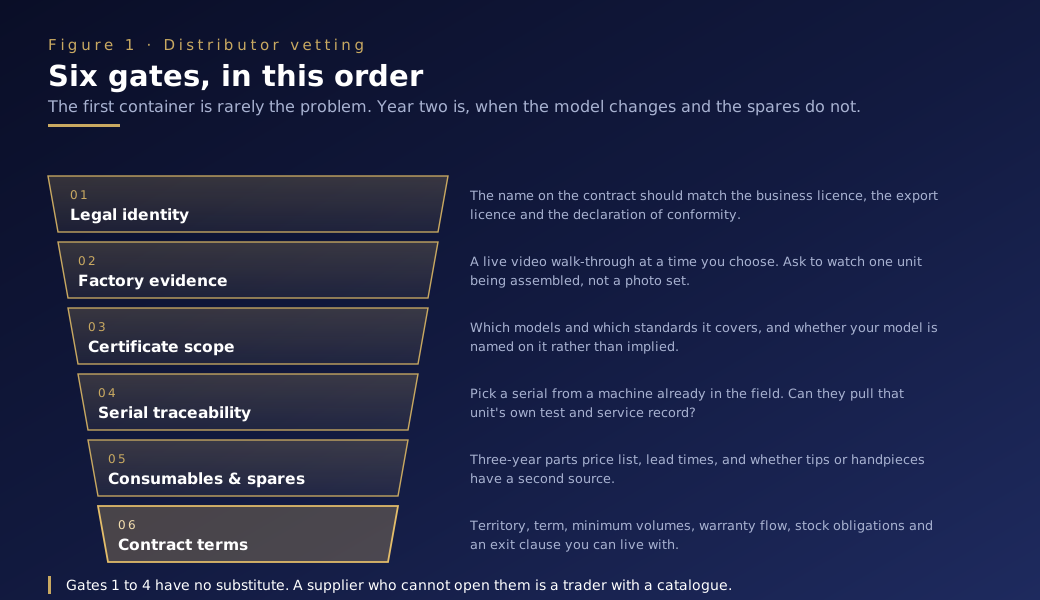
The Sample Unit Is the Least Useful Evidence
Samples are hand-built, checked twice and often tuned by the person who will also answer your first technical question. They tell you what the product can be. They do not tell you what the production line will send you in the third container, when the order is routine and nobody is watching.
So treat the sample as a floor, not a ceiling. The real evidence is whether the manufacturer can show you a unit pulled from current stock, with its own test record, and whether the line that builds it also builds anything else you would recognise.
Gate 1 — Legal Identity
Before anything technical, confirm who you are actually contracting with. The name on the agreement should match the business licence, the export licence, the bank account and the name printed on the declaration of conformity. When those five diverge, you are usually dealing with a trading company in the middle — which is not automatically a problem, but it changes who is responsible when something goes wrong.
Ask for the registration document and the name of the legal representative, then check that the same entity appears on the invoice and the warranty. A contract with one company and an invoice from another is a dispute waiting for a reason to happen.
Gate 2 — Factory Evidence
A photo set proves that a factory exists somewhere. It does not prove that your model is built there. Ask for a live video walk-through at a time you choose, and ask to see a specific model being assembled — not the showroom, not the demo bench, the production bench.
During the call, look at three things: whether the person holding the phone knows the line without being prompted, whether there is work in progress that matches your order volume, and whether they will walk to the test area without rearranging the route. A manufacturer is comfortable in its own plant. A trader is comfortable in a meeting room.
Gate 3 — Certificate Scope
Certificates are the easiest thing to wave and the easiest thing to misread. What matters is not the logo at the top but the scope written inside: which models, which standards, whose name, and which laboratory produced the underlying test reports.
Check that your exact model is named, not covered by a family description that may have been written before the model existed. Check the report numbers and the dates. And check the standards cited against what your market actually requires — a declaration of conformity is the manufacturer's assertion that the product meets the cited standards, which is why the test reports behind it are the part worth reading. Our import compliance guide walks through the document set in the order customs will ask for it.
Gate 4 — Serial Traceability
This is the check that separates a manufacturer from an assembler, and almost nobody runs it. Take a photo of a unit already in the field — your own demo, a competitor's showroom, a clinic you know — read the serial number, and ask the supplier to pull that unit's build and test record.
A real manufacturer can tell you when it was built, which batch the components came from, what firmware it shipped with and whether it has had a service claim. A supplier who cannot do this for a unit they sold is telling you that the serial number is decoration, and that in year two they will not be able to trace a fault to a batch either.
Gate 5 — Consumables and Spares
Hardware is the visible cost; consumables and spares are the cost that decides whether the relationship works. Ask for a parts price list covering at least three years, with lead times, and ask which parts are proprietary. Handpieces, tips, cartridges, cables, screens and power supplies are the items that take a machine out of service, and they are the items most often left out of a distribution conversation until the first failure.
Two specific questions are worth more than the whole list. First: can you buy spares at a stated price, or only through a service contract? Second: do the tips or cartridges have a second source, or does every treatment consume an item only this supplier can sell? That single answer shapes your margin for the life of the agreement, and we covered the arithmetic in our consumable lock-in guide.
Gate 6 — Contract Terms
By the time you reach the contract, the technical questions should be settled and the document should be boring. The clauses that matter are the ones you hope never to use:
- Territory defined by countries or postcodes, not by a vague "region".
- Term and review date, so exclusivity is earned again rather than granted forever.
- Minimum volume that is achievable in a bad year, not only in a good one.
- Price protection — how much notice before a price change, and whether stock already ordered is protected.
- Warranty flow — who pays labour, who ships the part, and how long the customer waits.
- Stock and exit — what happens to unsold units, demo units and outstanding warranty claims if the agreement ends.
- Brand use — what you may and may not claim, including the trademarks you do not own.
A contract with no exit clause is not a partnership; it is a commitment with one direction of travel.
The Documents, and What Each One Actually Proves
| Document | What it proves | What it does not prove |
|---|---|---|
| Business licence | The legal entity exists and its registered scope | That it owns or operates a factory |
| Export licence | The right to export from its jurisdiction | Manufacturing capability or product quality |
| Declaration of conformity | The manufacturer asserts the model meets the cited standards | That every unit was individually verified |
| Test reports | A sample was tested against those standards, by a named laboratory | That your production unit matches the tested sample |
| Serial-level test record | The specific unit was built and tested | Long-term reliability in your market |
| Spare parts price list | Parts are priced and can be ordered | That they will still be available in three years |
| Warranty terms | Who is responsible for what, and for how long | How quickly a claim is actually handled |
Test One Unit Yourself
Order a single unit at distributor price and treat it as the real qualification. It is the cheapest part of the whole process and the only test you control end to end. What to check, in order:
- Output against the datasheet — the settings you were quoted, measured or at least verified against a known reference.
- Warm-up and stability — how long to full output, and whether it holds after an hour.
- Noise and vibration — a machine that is unpleasant to sit beside will not be used for long treatments.
- Screen and software — number of taps to start a treatment, language options, and whether settings survive a power cycle.
- Handpiece fit and weight — for a full day of treatments, ergonomics decide throughput.
- Consumable consumption — count the tips or cartridges used in a realistic protocol and compare with the supplier's claim.
- Packaging — a drop test on the carton tells you how the second container will arrive.
- Firmware and documentation — version number, change log, and a manual in a language your therapists read.
Keep a written record of every check. If the unit passes, you have a baseline for every future container; if it fails, you have found out before your reputation is involved.
Reference Calls Worth Making
Ask for two distributors in markets comparable to yours — similar regulation, similar price expectations, similar clinic size. Then call them without the manufacturer on the line, and ask about the second year rather than the first: how fast were spare parts, how were warranty claims handled, did the model change without notice, was the territory respected.
Most suppliers will give you references who are happy. The useful question is not whether they are happy, but what specifically went wrong and how it was resolved. A reference who cannot name a single problem is either new or not being candid.
Red Flags That End the Conversation
- Price before specification. A quote that arrives before the datasheet is a quote you cannot compare.
- Exclusivity offered immediately. Territory given away before any volume discussion is territory nobody else wanted.
- "The certificate will follow." Documents that exist can be sent today.
- No live video call, ever. There is no legitimate reason to refuse one.
- No serial number on the unit or the carton. Traceability starts at the label.
- Contract and invoice from different entities. Find out why before you sign, not after.
- Spares "available on request" with no list or lead time. That is not availability; it is hope.
- The same chassis under three brand names, undisclosed. You will meet your own supplier's competing distributor.
- A warranty that excludes the handpiece. The handpiece is the part that fails.
What a Workable Agreement Contains
Beyond the six gates, a distribution agreement that survives contact with reality usually has four practical features: a named contact who answers technical questions, a documented process for warranty claims with response times, a marketing asset pack you are licensed to use, and a review meeting on a fixed date where both sides look at the numbers together.
None of this is exotic. It is simply the difference between buying machines and building a line of business on somebody else's product.
How We Work With Distributors
We are a manufacturer, not a trading company, and we structure distributor relationships so the checks above are easy to run. You can see the plant on our factory tour page, the certification documents on our certificates page, and the OEM and branding options on the OEM page. Every unit ships with a serial-linked test record, and our platforms share consumables and service procedures across the range, which keeps spares simple as your portfolio grows.
If you are evaluating several suppliers, send us the shortlist and we will tell you which questions to put to each of them. If the answer is that a different supplier fits your market better, we will say so — a distributor who buys the wrong platform is not a customer in year two.
Frequently Asked Questions
Do I need to visit the factory before signing a distribution agreement?
A live video walk-through is the minimum. For a first agreement with a meaningful minimum order, an in-person visit is worth the trip: you see the line, the test bench, the warehouse and the people who will handle your service claims.
Which certificates should an aesthetic equipment manufacturer provide?
At minimum the declaration of conformity for the models you are buying, with the standards cited and the test reports behind it, plus the business and export licences. Check that your model is named in the scope rather than covered by implication.
How can I confirm a supplier actually manufactures the machine?
Ask for a live walk-through of the line, a unit pulled from current stock rather than a demo, and the test record tied to a serial number. A trader can usually produce a catalogue and a sample; a manufacturer can produce the build and test record for a specific unit.
What should an exclusivity clause contain?
A defined territory, a term with a review date, a minimum volume, a price-protection mechanism, and an exit path covering remaining stock and warranty obligations. Exclusivity without a performance condition is a one-way commitment.