
The goggles in the drawer are probably the wrong ones. Not damaged, not missing — wrong. They were bought for the first device the clinic owned, and the room now holds three more, each emitting at a wavelength the original lens was never rated to stop. This is the most common safety gap in a growing aesthetic practice, and it is invisible until somebody audits the markings on the frame. Room safety is not a poster on the door. It is two separate hazard families, each with its own control, plus a written record that proves the controls were in place on the day.
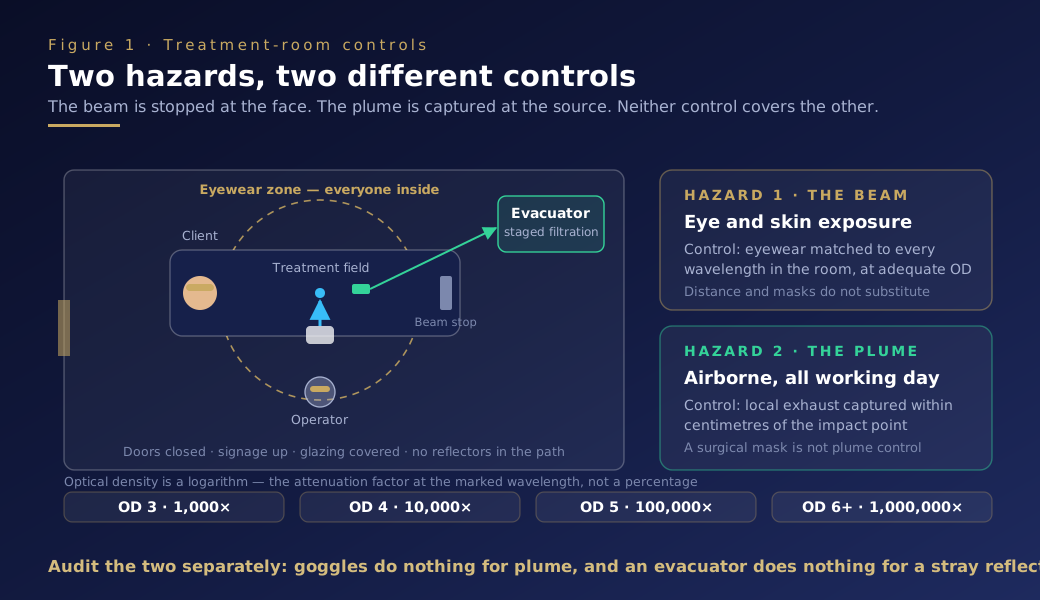
Two Hazard Families That Get Confused
Everything a laser or light-based device does to tissue produces two distinct exposures, and they are governed by different logic:
- The beam and its reflections. A collimated or reflected beam entering the eye is focused by the cornea and lens onto a spot on the retina far smaller than the beam itself. The concentration factor is enormous, which is why even a low-power reflection can matter and why the control is optical filtration at the face, not distance and not a mask.
- The plume. When tissue is vaporised — ablative fractional work, electrocautery, any device that removes material by heat — what was solid becomes airborne. That is a respiratory exposure for everyone in the room over a whole working day, and the control is capture at the source, not eyewear and not a surgical mask.
A room can be perfectly compliant on the first family and completely uncontrolled on the second. Buying goggles does nothing for plume; buying an evacuator does nothing for a stray reflection. Audit them separately.
Eyewear: Optical Density Is Per Wavelength
The number printed on laser eyewear is optical density (OD), and it is a logarithm, not a percentage. OD is the base-10 logarithm of the ratio of incident to transmitted light:
| Marking | Attenuation factor | What it means in practice |
|---|---|---|
| OD 3 | 1,000× | One thousandth of the incident light passes at the rated wavelength |
| OD 4 | 10,000× | A common minimum for alignment and low-power work |
| OD 5 | 100,000× | Typical of protection against direct intrabeam viewing at the rated band |
| OD 6+ | 1,000,000× | Higher-power applications; the frame must also survive the thermal load |
Three consequences follow, and they are the ones that catch clinics out:
- OD is stated against a wavelength range, not against "laser". A lens marked OD 5 at 1064 nm may be close to transparent at 532 nm. The filter works by absorbing or reflecting specific bands; outside those bands it is ordinary tinted plastic. If your room runs a frequency-doubled device, the green output needs its own coverage — the same physics that makes 532 nm and 1064 nm behave differently in tissue makes them behave differently in a filter.
- Every emitter in the room counts, including the aiming beam. A device may have a visible pilot laser at a different wavelength from the treatment output. The eyewear must cover both, plus anything else that fires in that room on other days.
- The rating assumes an intact lens. Scratches, crazing, solvent damage and delamination all degrade it, and a lens that has taken a direct hit should be withdrawn rather than wiped down. Inspect on a schedule and record the inspection.
Practical rule: build an inventory of every wavelength present in each room, then buy eyewear whose marked range covers the whole inventory at an OD appropriate to the highest-power device in it. Everyone inside the controlled area wears it — operator, assistant, and the client, whose protection is usually a smaller insert or a shield rather than a frame. Eyewear that does not fit over prescription glasses will simply be taken off, so solve the fit problem at purchase.
Plume: Capture It Where It Is Made
Ablative and vaporising procedures turn tissue into an aerosol. The plume is mostly water vapour, but it also carries carbonised particulate, condensed organic compounds and fragments of whatever was in the tissue. A large share of the particulate is in the respirable size range, which means it does not settle on the drape — it stays in the air the room breathes.
What actually controls it:
- Local exhaust, positioned close. A filtered smoke evacuator with the capture nozzle held within a few centimetres of the impact point removes plume before it disperses. Capture efficiency falls off sharply with distance, so a nozzle parked on the trolley is decoration.
- Filtration matched to the hazard. A pre-filter for visible smoke, a high-efficiency particulate stage for the fine fraction, and an activated-carbon stage for the gaseous fraction. A single-layer filter is not the same device.
- A filter-change schedule that somebody owns. A loaded filter stops capturing and starts restricting flow, and the failure is gradual enough that nobody notices. Log changes by hours of use, not by appearance.
- Room ventilation as a backstop, never as the control. General air changes dilute what escaped capture. They do not protect the operator leaning over the field.
A surgical mask is not plume control. It is not sealed to the face, it is not rated for this particle loading, and it does nothing at all about the gaseous fraction. If your practice runs fractional ablative work, the evacuator is a core piece of equipment with a consumable line, and it belongs in the budget alongside the laser — the total cost of ownership model has a line for exactly this kind of item.
The Room Itself
Beam hazards are managed by controlling where the beam can go and who can be in the path:
- Signage at every entrance, stating the wavelengths in use and the eyewear requirement, with a clear indication of when the device is armed.
- Controlled access. Doors closed during firing; interlocks where the installation requires them; no through-traffic in a room that is also a corridor.
- A terminated beam path. The handpiece should never be pointed at anything but the field or a safe beam stop. No reflective instrument surfaces in the path, no jewellery or watches on the operator's hands, no mirrors or glass tabletops adjacent to the field.
- Windows and glazing covered for the wavelengths in use, so a beam cannot leave the room.
- Fire discipline. Alcohol-based skin prep must be fully dry before firing; no oxidiser-enriched atmosphere near the beam; drapes and gauze kept out of the path; an extinguisher rated for the room's contents within reach.
- Cooling treated as a safety system. Contact cooling protects the epidermis during delivery. A device whose cooling has failed or been bypassed is out of service, not uncomfortable — see how a diode platform uses its chilled window.
The Written Part Is the Part That Gets Audited
Controls that exist but are not documented are, for practical purposes, controls that did not happen. A workable file is small:
- A named person responsible for laser safety in the practice, with the authority to stop a session. The role does not need to be a full-time job; it does need to be assigned to a human rather than to "the team".
- A written protocol per device: wavelengths, maximum settings, eyewear specification, plume control method, room requirements, and the screening questions asked before treatment.
- Training records per operator, scoped to the devices they actually use, with a refresh interval.
- An eyewear inventory listing marked wavelength range and OD per pair, purchase date, inspection dates, and withdrawal of damaged pairs.
- A maintenance log covering cooling systems, evacuator filters, handpiece windows and calibration.
- An incident log, including near misses. A near miss recorded is a protocol improved; a near miss unrecorded is a repeat waiting to happen.
Requirements differ by country and by premises, and a local inspector may ask for more than this list. Treat it as a floor rather than a ceiling, and confirm the specifics with your own regulator before you open the room.
The Pre-Fire Checklist
| Check | Pass condition | If it fails |
|---|---|---|
| Eyewear | Marked range covers every emitter in the room; OD adequate; lenses intact; a pair for every person present | Do not fire. This is not a workaround-able item |
| Plume control | Evacuator running, filter within its logged life, nozzle positioned at the field | Do not fire ablative work; non-ablative work may proceed per protocol |
| Room | Signage up, doors controlled, glazing covered, no reflectors in the path | Correct the room before arming |
| Device | Cooling functional, handpiece window clean and undamaged, calibration current | Take the device out of service |
| Client | Screening questions answered, eye protection in place, prep dry, settings recorded | Postpone rather than compensate |
| Aftercare | Written sheet ready, red-flag list explained, review booked | Do not skip — this is where reviews are lost |
The red-flag list for what happens afterwards is in our seven-day skin response timeline. Knowing it before you fire is what lets you tell a normal day-two reaction from something that needs referral.
Frequently Asked Questions
Can one pair of laser goggles cover every device in the room?
Only if its marked wavelength range covers every emitter present, at an optical density adequate for the highest-power device among them. A lens rated OD 5 at 1064 nm may offer almost no protection at 532 nm. Build the room's wavelength inventory first, including aiming beams, then match the eyewear to it — and re-check the inventory whenever a device is added or moved between rooms.
Does a surgical mask protect against laser plume?
No. It is not sealed to the face, it is not rated for the particulate loading a vaporising procedure produces, and it does nothing about the gaseous fraction. Plume is controlled by local exhaust captured close to the impact point, with particulate and carbon filtration and a logged filter-change schedule. Room ventilation dilutes what escapes capture; it does not protect the operator at the field.
How close does the smoke evacuator nozzle need to be?
Within a few centimetres of the impact point. Capture efficiency drops sharply as the nozzle moves away, because the plume disperses into the room air faster than the inlet can draw it in. A nozzle resting on the trolley or clipped to the handpiece at a distance is not providing the control it appears to provide.
Who should be responsible for laser safety in a small clinic?
A named individual with the authority to stop a session. In a small practice this is usually the owner or the senior operator, and it is a documented role rather than a full-time job. What matters is that the protocols, training records, eyewear inventory and maintenance logs have an owner, because an unassigned safety file is the first thing an inspector finds missing.
What to Put in the Purchase Order, Not Just the Room
- Eyewear specified by wavelength range and OD for the devices you are actually buying, with enough pairs for everyone who will be in the room.
- A smoke evacuator with staged filtration if any device you are buying vaporises tissue, plus the filter part numbers and the recommended change interval in writing.
- The manufacturer's own safety documentation — the warnings, the required room conditions and the eyewear specification printed in the manual, not improvised afterwards.
- Operator training scoped to the delivered devices, including what to do when cooling fails mid-session.
- A beam stop and non-reflective accessories where the handpiece geometry calls for them.
- Spare handpiece windows and cooling consumables, because a device waiting on a small part is a device out of service.
Operator safety carries real weight in the weighted buying scorecard for this reason: it is the criterion that cannot be compensated by a lower price elsewhere. If you are fitting out a room from scratch, our training programme and the laser platform category are the two places to start the conversation.