Three numbers get quoted at you in every diode laser sales conversation — 755, 808 and 1064 — and almost nobody explains that they are not three grades of power. They are three different answers to one physical problem: how to heat a pigmented shaft under the skin without heating the pigmented surface above it. The wavelength decides how much of the beam melanin intercepts on the way down, and how far the beam travels before it is scattered away. Everything else — fluence, pulse width, spot size, cooling — is negotiation around that one choice. This article walks the trade-off so you can read a spec sheet as a set of consequences rather than a set of features.
The Target Is Fixed. The Window Is Not.
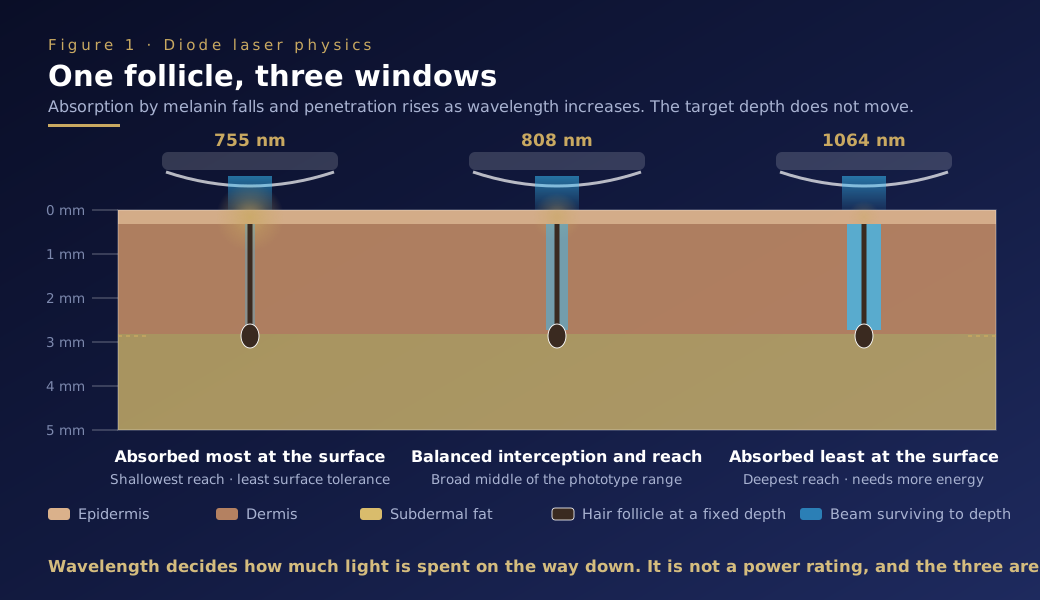
A terminal hair follicle sits a few millimetres down, and the pigment you want to heat is in the shaft and the bulb. Above it lies the epidermis, which in most phototypes contains melanin of its own. That is the whole difficulty: the chromophore you are aiming at and the chromophore you must protect are the same molecule. Selective photothermolysis — the principle that lets you heat one structure and spare its neighbour — is covered in depth in our explainer on the mechanism. For wavelength choice, three consequences matter:
- Melanin absorption falls as wavelength rises. Across the near-infrared window used for hair removal, 755 nm is absorbed most strongly, 808 nm less, 1064 nm least. Stronger absorption means more heat per unit of delivered light — in the target and in the surface.
- Scattering falls as wavelength rises. Longer wavelengths deviate less as they pass through tissue, so a greater fraction of the beam still travels forward at depth. This is why 1064 nm is described as the deeper option even though it is the least absorbed.
- Water absorption starts to matter at the long end. Beyond roughly 900 nm the tissue's water content begins to take a share of the energy. At 1064 nm this is a modest contribution rather than the main event, but it is one reason the long wavelength is not simply "808 but better".
Put those together and the trade-off is unavoidable: the wavelength that finds a weak, fine target most efficiently is also the wavelength that the surface intercepts most efficiently. There is no setting that escapes it. There is only a choice about which edge of the range your clientele actually occupies.
What Each Wavelength Is Actually For
| Wavelength | Melanin absorption | Relative penetration | Where it earns its place | Where it costs you |
|---|---|---|---|---|
| 755 nm | Highest of the three | Shallowest | Fair skin with fine, lightly pigmented or blonde-ish hair that a longer wavelength struggles to load with heat | Least tolerance for epidermal pigment; recent sun exposure is a hard stop rather than a caution |
| 808 nm | Middle | Middle | The broad centre of the phototype range and the broad centre of hair thickness — the workhorse configuration | Not the best tool at either extreme; very fine hair on very fair skin and very dark skin both sit outside its optimum |
| 1064 nm | Lowest of the three | Deepest | Deeper, coarser terminal hair and higher phototypes, where the surface must be spared on the way down | Needs more delivered energy to reach the same follicle temperature; weak targets may simply not absorb enough |
Notice what the table does not say. It does not rank the three. A clinic whose book is mostly phototype II–III with medium hair is not underserved by 808 nm; a clinic serving predominantly phototype V–VI is not well served by pretending 755 nm is a premium upgrade. The right wavelength is a property of your client mix, not of the price list.
Pulse Width Is the Other Half of the Decision
Wavelength chooses where the light goes. Pulse duration chooses whether the heat stays where you put it. A hair follicle is a relatively large structure and sheds heat slowly — its thermal relaxation time is measured in tens of milliseconds. Epidermis is thin and sheds heat fast. That difference is the entire safety margin:
- Pulses in the millisecond range let the follicle accumulate heat while the surface conducts its share away between and during shots. This is the hair-removal regime.
- Pulses in the nanosecond or picosecond range deposit energy faster than any structure can shed it, which is what you want for shattering a small pigment target — and exactly what you do not want when the surface is full of the same pigment. That regime belongs to pigment work on Q-switched and picosecond platforms, not to a hair-removal handpiece.
Practical consequence when you compare quotes: a machine advertising 1064 nm capability is not thereby a dark-skin machine. Ask for the pulse-width range at the wavelength you intend to use, and ask whether the cooling system is rated for continuous operation at that combination. Two suppliers can print the same three numbers and deliver very different working envelopes.
Spot Size, Cooling and the Numbers That Move Depth
Three further parameters change the effective depth as much as the wavelength does, and they are where spec sheets get quietly creative:
- Spot size. A larger spot loses less light sideways out of the beam, so a greater fraction survives to depth. A large-spot 808 nm handpiece can reach further than a small-spot 1064 nm one. Compare spot dimensions before you compare wavelengths — and check whether the quoted spot is the emitting aperture or the footprint after the optics.
- Contact cooling. A chilled window in firm contact with the skin protects the epidermis while the beam passes through it, and it is what allows a useful fluence at all. Treat it as a safety component with a maintenance schedule, not a comfort feature. Our note on how an 808 nm diode platform works covers why a bypassed cooling system means the machine is down.
- Fluence and repetition rate together. Energy per area per shot, multiplied by shots per second, is the thermal load the room and the machine both have to absorb. A high repetition rate at low fluence is a different clinical proposition from a low rate at high fluence, even when the average power figure looks identical.
If you want a systematic way to interrogate these figures rather than collecting them, the nine-number spec sheet guide sets out the unit traps — peak versus continuous power, aperture versus footprint, and the duty cycle nobody prints.
Reading Your Own Booking Book Before You Read a Brochure
The decision procedure is short, and it runs on your data rather than the supplier's:
- Count phototypes, not preferences. Take the last hundred hair-removal clients and record the phototype distribution. If the great majority sit in the middle of the range, a single-wavelength platform is the cost-efficient answer and the add-ons are inventory you will rarely use.
- Count the failures you already have. Fine hair that never responded, and higher phototypes you turned away or postponed, are the two edges. Each edge you actually meet is a case for an additional wavelength; each edge you do not meet is a case against.
- Check the consumable and service consequence. More wavelengths can mean more handpieces, more calibration, more spare parts and more operator training. The total cost of ownership model is the place to put those lines, because they never appear in the purchase quote.
- Ask for the envelope in writing. For each wavelength you are considering: fluence range, pulse-width range, spot size, repetition rate, and the continuous-operation rating of the cooling system. A supplier who answers with a single "up to" figure per line has not answered.
Our own hair-removal platform is specified as a single-wavelength 808 nm system at 800 W, on the reasoning above: it covers the broad middle of the phototype range in one handpiece, and adding wavelengths raises cost and capability you may not need. That is a position, not a universal truth — if your book skews to one edge, say so and specify accordingly. The laser hair removal category page lists the configuration questions we ask every buyer before quoting.
Frequently Asked Questions
Is 1064 nm safer for dark skin than 808 nm?
It is more forgiving, not automatically safe. Melanin absorbs 1064 nm less strongly than 808 nm, so less of the beam is intercepted by epidermal pigment on the way down and more reaches the follicle. That widens the margin between a follicle-heating dose and a surface-heating dose. It does not remove the margin: fluence, pulse width, contact cooling and recent sun exposure still decide the outcome, and a test patch is still the right first step.
Why does 755 nm work better on fine, light hair?
Because a thin, lightly pigmented shaft contains very little melanin, and 755 nm is absorbed by that melanin more strongly than the longer wavelengths. The trade-off is that it is also absorbed more strongly by the epidermis, so the same advantage that lets it find a weak target makes it less tolerant of pigment in the surface. It is a fair-skin, fine-hair tool rather than a universal one.
Do I need a triple-wavelength handpiece to cover every client?
Usually not. A single 808 nm platform with adequate output and real contact cooling covers the broad middle of the phototype range, which is where most clinics find most of their clients. Adding 755 nm and 1064 nm buys capability at the two edges of the range and raises both purchase cost and consumable complexity. Decide from your own booking book, not from the brochure.
Does a longer wavelength always reach deeper?
All else equal, yes — scattering falls as wavelength rises, so longer wavelengths penetrate further into the dermis. But all else is rarely equal. Spot size, fluence, pulse width and the cooling method change the effective depth as much as the wavelength does, and a large-spot 808 nm handpiece can out-penetrate a small-spot 1064 nm one. Compare delivered parameters, not the number on the label.
Before You Sign: The Wavelength Clause
- The wavelengths you are buying, named individually — not "multi-wavelength platform" as a line item.
- Fluence range, pulse-width range and spot size per wavelength, in the units you will actually set on the screen.
- Continuous-operation rating for the output and cooling combination you intend to run all day, not the peak figure.
- Which handpieces are included and which are optional, with the price of each optional one stated before you commit.
- A test-patch protocol supplied by the manufacturer for the phototypes at the edges of your range.
- Operator training scoped to the wavelengths delivered, because the settings that are safe at 808 nm are not transferable to 755 nm by analogy.
None of these are exotic requests, and a factory that builds the platform answers all six without hesitation. If you are still comparing suppliers, the six-gate vetting routine is the faster way to narrow the field before you get to parameters.