
A client who asks for "fat freezing" and a client who asks for "muscle building" are describing two different tissues, and no machine answers both well. Body contouring is the category where marketing language has drifted furthest from the physics, partly because three genuinely different mechanisms got sold under one umbrella word — "sculpting" — and partly because the before-and-after conversation is easier to have than the mechanism conversation. This article separates the three by what they act on, what the client actually experiences, and what each one costs you to run. It is written from the factory side: we build electromagnetic and ultrasonic body platforms, and we will say plainly where a technology sits outside our own range.
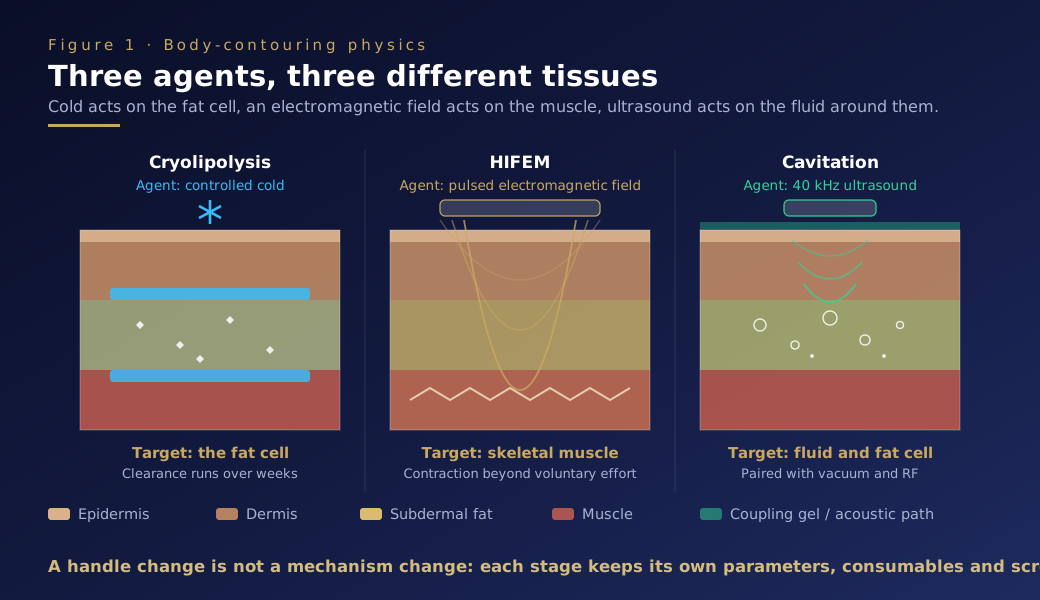
Start With the Tissue, Not the Machine
Shape in a treated area is produced by at least three things: the volume of the fat layer, the tone and bulk of the muscle underneath, and the condition of the connective tissue and fluid between them. Each body technology reaches one of those, and reaches it by a specific physical event:
| Technology | Physical agent | Primary target | The event that does the work |
|---|---|---|---|
| Cryolipolysis | Controlled cooling, held for a cycle | Adipocytes in the subcutaneous fat layer | Lipid-rich cells crystallise at a temperature above the point where water freezes; the tissue response and clearance follow over weeks |
| HIFEM | High-intensity focused electromagnetic field | Skeletal muscle in the field | Induced current depolarises motor nerves, producing contractions far beyond what voluntary effort recruits |
| Cavitation | Low-frequency ultrasound | Interstitial fluid and the fat cells suspended in it | Pressure cycles form and collapse microbubbles, and the mechanical action stresses adipocyte membranes |
| Vacuum / RF (adjuncts) | Mechanical suction; resistive heating at radiofrequency | Tissue mobility, fluid movement, dermal collagen | Suction mobilises the field; RF raises tissue temperature by resistive loss |
Read that table as a set of non-substitutes. A device that contracts muscle does not crystallise fat. A device that cavitates fluid does not recruit motor units. When a supplier describes one machine as doing all of it, what is usually being described is a handle change — which is a real product, but it is several mechanisms in one chassis, each with its own parameters, its own consumables and its own evidence base.
Cryolipolysis: Selective Cold, and a Delayed Answer
The mechanism rests on a difference in composition. Fat cells are lipid-rich, and lipid crystallises at a higher temperature than water does. Cool a fold of tissue to the window where fat crystallises but the water-rich surrounding tissue does not freeze, hold it there for a defined cycle, and the adipocytes are injured while the skin, vessels and nerves above them are largely spared. The visible change is not immediate: the body clears the injured cells over the following weeks, which is why the honest comparison point is months rather than days — the same remodelling logic that governs every energy-based treatment.
Operationally, three things define the category:
- Applicator fit is the treatment. The tissue must be drawn into a cup or held between plates so the cooling surfaces contact it evenly. A poorly matched applicator treats the edges of a fold and misses the centre, and no amount of cycle time repairs that.
- Cycle time sets your diary. A cooling cycle is a fixed block during which the applicator is occupied. Throughput is a function of how many applicators you own and how many cycles each can run per day, not of how fast the operator works.
- There is a consumable layer. Protective membranes between skin and cooling plate are single-use on most platforms, and they are a per-session cost that belongs in your pricing model.
Where we stand: cryolipolysis is not part of the KOLIFU body range. We build electromagnetic and ultrasonic platforms. If your market specifically asks for cold-based contouring, that is a different purchase from a different supplier, and the applicator inventory and membrane cost should be quoted alongside the chassis before you compare it against anything below.
HIFEM: The Target Is Muscle, and the Field Does the Recruiting
A high-intensity focused electromagnetic field induces current in conductive tissue without passing current through the skin. In muscle, that induced current depolarises motor nerves, and the resulting contraction is supramaximal — it recruits motor units that voluntary effort cannot reach, at a rate no exercise session sustains. The mechanism, the firing patterns and the applicator geometry are covered properly in our HIFEM explainer; the points that matter for a comparison are these:
- It is a workload, not a heat treatment. The client experiences intense contraction, and the day after resembles the day after hard training. That framing is also the screening logic: anything that makes exercise inadvisable makes this inadvisable.
- Applicator geometry decides coverage. Two machines with the same field strength can treat very different amounts of tissue per session depending on the size and shape of the applicator and how many can run at once.
- EMC is the certification that bites here. A device that deliberately generates a strong pulsed electromagnetic field is exactly the device that electromagnetic compatibility testing exists to constrain. Ask for the EMC report, not just the mark.
- Consumables are light. There is no per-shot cartridge in the field path on most platforms, which changes the cost-per-session arithmetic substantially against metered technologies.
Cavitation: Sound Into Bubbles, and Bubbles Into Mechanical Work
Low-frequency ultrasound propagating through tissue produces alternating pressure cycles. In the fluid between cells, those cycles form microbubbles which grow and collapse; the collapse is a local mechanical event. Applied to a fat layer, that mechanical action stresses adipocyte membranes, and the released content enters the body's normal handling routes. On our body platform the cavitation stage runs at 40 kHz, which is the low-frequency end of the range used for this purpose — lower frequency means larger bubbles and a more pronounced mechanical action, at the cost of less precise depth control.
What the physics demands in practice:
- A conductive medium, always. Ultrasound does not cross an air gap. Gel is not an accessory; it is part of the acoustic path, and it is a recurring consumable line — the same buying logic as conductive gel for RF work.
- Movement, not parking. The transducer is kept moving over the field. Holding it stationary concentrates energy in one place, which is a comfort and safety problem rather than an efficacy gain.
- It is usually paired, and the pairing is the point. Cavitation alone releases material into the interstitium; vacuum and RF are what move fluid and raise tissue temperature afterwards. On our platform the vacuum stage reaches 80 kPa and the RF stage offers 1, 3 and 5 MHz, which is why it is specified as a combined body system rather than as a cavitation handpiece.
- The client hears it. Low-frequency ultrasound in tissue is audible as a ringing or buzzing tone. Warn people beforehand; it is normal, and it is the single most common source of mid-session alarm in this category.
Vacuum and RF: Supporting Cast, Not Headliners
Mechanical suction mobilises the tissue fold, moves interstitial fluid and makes the field accessible to the other stages. Radiofrequency heats by resistive loss — current passing through tissue encounters impedance and dissipates energy as heat — and the dermal response to controlled heating is a collagen remodelling process running on the same weeks-to-months clock as everything else in this article. Neither is a standalone answer to fat volume, and a menu that sells them as such is setting up a refund conversation. They earn their place as connectors: they make a session feel complete, they extend the indications of the primary stage, and they fill diary gaps between anchor appointments. The treatment menu design guide sets out that entry / connector / anchor structure in full.
What None of These Technologies Do
Stating the limits is not pessimism; it is the thing that keeps a clinic out of trouble:
- None of them is a weight-management treatment. They act on local shape in a treated field. They do not change energy balance, and a client who expects the scale to move will be disappointed by a physically successful course.
- None of them delivers a finished result in one session. Every mechanism here is followed by a biological response that runs for weeks. Selling a single visit as the outcome is the fastest route to a bad review.
- None of them treats a medical condition, and none should be described as doing so. These are aesthetic devices for professional use, and the screening conversation belongs to the client's own physician where there is any doubt.
- No honest supplier gives you a percentage. Response depends on the baseline tissue, the parameters delivered, the course structure and the individual. Any number quoted as a guaranteed outcome is a number somebody invented.
Choosing by Menu Economics, Not by Mechanism Novelty
Once the physics is understood, the buying decision is mostly operational. Compare on these lines:
| Line | Cryolipolysis | HIFEM | Cavitation + vacuum / RF |
|---|---|---|---|
| Operator hands-on time | Low during the cycle — applicator placement, then supervision | Low during the cycle — placement and monitoring | High — the transducer is moved by hand throughout |
| Session block | Fixed cooling cycle per applicator | Fixed protocol block per applicator | Variable, set by field size and stages combined |
| Throughput lever | Number of applicators and cycles per day | Number of applicators running simultaneously | Therapist hours — it does not scale without people |
| Consumable load | Single-use protective membranes per session | Light; no metered cartridge in the field path | Gel every session; wear items on handpieces |
| Rebooking logic | Course with a long interval, then a review | Course with a short interval, then maintenance | Course plus maintenance; suits a connector slot |
| Room requirement | Space for applicator inventory and cycle storage | Field clearance; EMC-conscious installation | Couch, trolley, gel, and a therapist for the whole block |
The pattern worth noticing: the two cycle-based technologies buy throughput with hardware, and the hands-on technology buys throughput with payroll. A clinic with more rooms than therapists should weight that differently from a solo operator. Put the consumable and staffing lines into the budget allocation model before you fall in love with a mechanism, and use the weighted scorecard to keep the comparison honest across suppliers.
Screening: Location and Material Questions, Not Diagnoses
Each of these mechanisms has real exclusions, and none of them requires naming a condition to communicate. Metal or electronic implants in or near the field, pregnancy and breastfeeding, recent surgery or an abdominal wall defect in the area, and anything the client's own physician has told them to avoid exercising — that list covers the electromagnetic side and is set out in full in the HIFEM explainer. Cold-based work adds its own questions about cold tolerance and circulation in the area to be treated, and ultrasonic work adds questions about the acoustic path and the tissue over it. Write the intake form once, per mechanism, and make it part of the booking rather than part of the conversation on the couch.
Frequently Asked Questions
Can one machine do cryolipolysis, HIFEM and cavitation?
Not as one mechanism. A chassis can host several stages with interchangeable handles, and some do — but each stage keeps its own physics, parameters, consumables and screening list. When a supplier claims all three, ask which handles are included, what each one's consumable cost is, and whether the certification covers every stage or only the one that was tested.
Which body technology gives the fastest visible change?
None of them gives a finished result at the end of the appointment. Cold-based work is followed by a clearance process over weeks; electromagnetic work produces a training-like response that builds across a course; ultrasonic work depends on the body handling what the mechanical action releases. The fair comparison point is months, and any promise of a same-day outcome is describing swelling or fluid shift rather than a durable change.
Does cavitation need gel, and does it matter which gel?
Yes, and yes. Ultrasound does not cross an air gap, so the gel is part of the acoustic path rather than a comfort item. A gel that dries out or separates mid-session breaks the coupling and forces you to stop and reapply. Buy on conductivity, viscosity and how it behaves under a moving transducer, not on scent or packaging.
Is HIFEM a fat treatment or a muscle treatment?
Primarily muscle. The field depolarises motor nerves and produces contractions that voluntary effort cannot recruit; the tissue that responds first and most directly is skeletal muscle. Anything else that changes in the area is a secondary consequence of that workload and of the metabolic activity around it, and it should be sold as such rather than as a fat-removal claim.
What to Ask Before You Commit to a Body Platform
- Which mechanisms are in the chassis, named individually, and which handles are included versus optional.
- The parameters per stage — cavitation frequency, vacuum range, RF frequencies, field intensity and firing pattern for electromagnetic work, cycle structure for anything else.
- Applicator geometry and how many run at once, because that is your throughput, not the power figure on the box.
- Consumable part numbers and per-session cost for membranes, gel and wear items, in writing.
- The certification scope per stage, with the EMC report available for any device generating a pulsed field.
- Training and an intake form per mechanism, so the screening list exists before the first client rather than after the first complaint.
Our own body range is the HIFEM platform and the combined cavitation, vacuum and RF system, with the vacuum therapy platform as a connector option. The body contouring category page lists them side by side, and the configuration questions we ask before quoting are the same six as above.