
Every other body machine works by damaging tissue with heat or cold. HIFEM works by making the muscle exercise itself — which changes every question you ask the supplier.
Sort the body-contouring aisle by mechanism and it splits cleanly. One group destroys fat cells with temperature — controlled cooling, cavitation, radio frequency. The other group, HIFEM, does not damage anything with heat at all. It stimulates the nerve, the muscle contracts, and the tissue responses follow from that contraction.
That distinction is worth an hour of your attention, because it changes which specifications are load-bearing, which safety documents apply, and what you can honestly tell a client about the sensation.
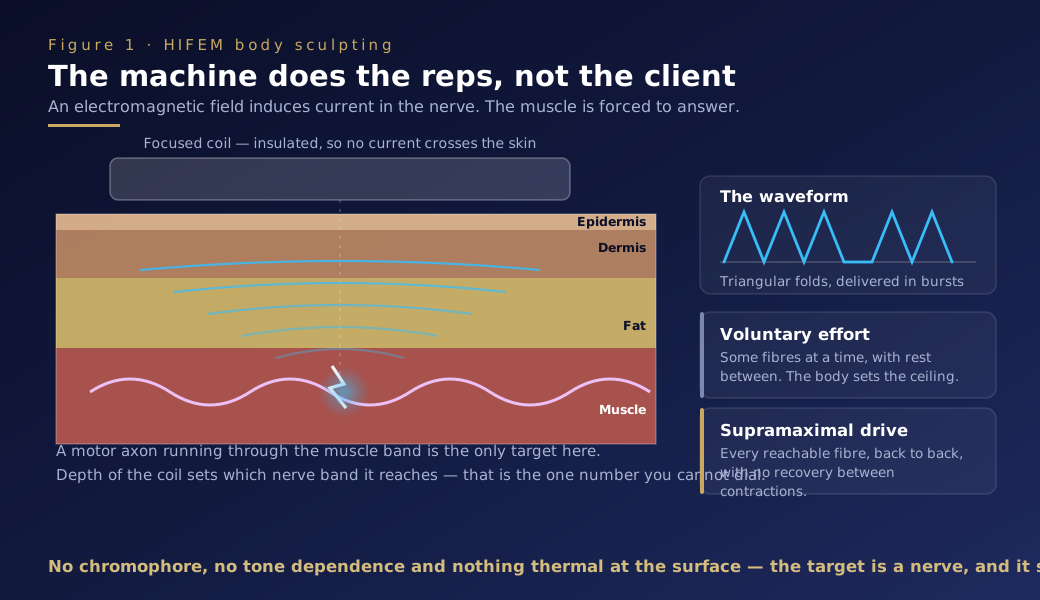
Electromagnetic Induction, Not Current Injection
HIFEM stands for High-Intensity Focused Electromagnetic. The handpiece is a coil. A rapidly switched current through that coil produces a changing magnetic field, and a changing magnetic field induces an electric field in whatever sits inside it — including the motor neurons running through the muscle below the applicator. Faraday's law, and no electrodes on the skin.
Three consequences fall straight out of that design, and each is a buying criterion:
- The magnetic field is not attenuated by skin or fat. Light-based devices lose energy to absorption and scattering on the way down — see how chromophores limit a laser. A magnetic field passes through the layers essentially undiminished and acts on the nerve where the nerve is.
- No contact cooling, no gel coupling requirement, no burn risk from the field itself. The applicator does warm, from induced currents in its own structure and from eddy heating of the patient, but the mechanism of action is not thermal.
- Nothing has to be absorbed. There is no chromophore to match, so skin colour is not a variable in the treatment. That is unusual in this aisle, and it is worth saying plainly to clients choosing among the modalities on your menu.
Why the Contraction Is Called Supramaximal
Voluntary exercise recruits motor units in a fixed order: small, slow, fatigue-resistant fibres first, and only as effort rises does the nervous system bring in the large fast-twitch fibres. It is a conservation strategy, and it is why you cannot simply decide to recruit your whole muscle at once — the nervous system will not let you.
An induced electric field does not ask. It depolarises the motor axons where they run through the muscle, and it does so regardless of fibre type and regardless of the orderly recruitment the nervous system normally enforces. The result is a contraction involving far more motor units than voluntary effort can produce, delivered at a firing rate high enough that the muscle cannot relax between stimuli — a fused, sustained contraction.
For a clinic, this is the honest way to describe the machine: it forces a workload the client could not achieve voluntarily, in a muscle they cannot choose to fatigue. Everything else the technology is credited with is downstream of that.
The Two Tissues That Respond
| Muscle | Adipose tissue sitting in the same field | |
|---|---|---|
| Direct action of the field | Yes — motor neurons are excitable tissue and are the intended target | No. Fat cells are not electrically excitable in this way and are not directly stimulated to contract |
| What follows the contraction | Mechanical overload at a recruitment level voluntary training cannot reach; the adaptive signalling that overload normally triggers | The proposed route: sustained contraction raises local metabolic demand and catecholamine-type signalling in the adjacent fat, driving triglyceride breakdown into free fatty acids |
| How solid the evidence is | The contraction is observable in real time. You can see it through the applicator | Less settled. The cascade is inferred from laboratory work; it is not visible in the room and you should not present it as visible |
| What the client feels about it | A hard, involuntary tightening and visible pulsing | Nothing at all, at the moment of treatment |
The practical rule for consultation scripts: describe what you can both observe — the contraction — and describe the fat-side mechanism as what the technology's literature proposes rather than what the client will feel. A KOLI-HIFEM platform is sold on both, and the two claims are not equally well-founded. Saying so is a trust move, not a weakness.
Intensity, Firing Pattern and What the Dial Does
There is no fluence in J/cm² to compare across machines here, because energy is not being delivered as light. What the spec sheet should carry instead:
- Field strength, in tesla, and at what distance from the coil. Peak field at the coil face and field at 3 cm depth are very different numbers, and only the second one describes a treatment on a body with a pannus.
- Pulse repetition pattern. Low rates produce discrete twitches; high rates produce the fused tetanic contraction the mechanism depends on. Machines differ in whether the pattern ramps, plateaus and ramps down, and that ramp is most of what the client experiences as comfort.
- Number of active channels. Four applicators driven simultaneously is a throughput figure that changes your unit economics more than field strength does — see the body sculpting category and the multi-applicator platforms.
- Treatment-time presets per applicator, since session length is set in firmware and it is what fills your diary slots.
Applicator Geometry Is Where Most of the Buying Decision Lives
The coil must sit over the muscle you intend to fire, and the coupling is mechanical — a pad or applicator held in position by a strap, on a curved body. Read the applicator set the way you would read a laser's spot sizes:
| Target | What the applicator has to do | What to verify before ordering |
|---|---|---|
| Abdomen | Large flat pad over the rectus, secured against a variable contour | How the pad handles a soft or high-BMI abdomen, where fat thickness increases the distance to the muscle |
| Glutes | Curved applicator on a muscle the client lies or stands against | Whether positioning is client-active or staff-assisted, and how repeatable placement is between sessions |
| Arms and thighs | Smaller applicators on a limb, with placement tolerance | Strap system quality and pad wear — these are consumables and they fail often |
| Anywhere with an implanter nearby | — | Whether the machine detects applicator lift and cuts the field, and how loud that shutdown is |
Vacuum-coupled RF body devices such as the vacuum RF sculpting platform solve the coupling problem with suction instead of a strap, and heat rather than stimulate. They are a different mechanism on the same client, which is precisely why a clinic needs to know which one they are describing.
What the Client Feels, and the Day After
| Window | Experience | What to say before the appointment |
|---|---|---|
| First minutes | Tapping and twitching as intensity ramps; the muscle visibly moving under the pad | Set expectations on the ramp — nobody's first session runs at the ceiling |
| Middle of the session | A sustained, hard contraction. Strong workout sensation, not heat, not sting. No pain control in the device beyond the intensity dial | Comfort is client-controlled by the dial, and a lower setting is a legitimate outcome for session one |
| Immediately after | Fatigued, warm muscle; skin untouched | No downtime, no redness, no coverage needed — this is the modality's genuine advantage |
| 24 – 72 hours | Delayed onset muscle soreness, the ordinary kind, in the treated muscle | Warn about it. Clients who expect nothing and receive soreness read it as injury |
| Beyond that | Nothing cutaneous to watch, which is why the skin-recovery timeline does not apply here | The absence of a visible healing phase is also the absence of visible proof — set that up front |
The Screening List, Written Without Diagnoses
A pulsed electromagnetic field has real exclusions, and a clinic that cannot state them is a liability. None of these require naming a condition to communicate — they are location and material questions:
- Any metal or electronic implant in or near the treatment path — the field induces current in conductive material, and that is the entire mechanism, applied somewhere it was not aimed.
- Pregnancy and breastfeeding: no protocol on a machine of this class, and no clinic should improvise one.
- Recent surgery, or any abdominal wall defect, in the area to be treated — a contraction against a repair line is a mechanical event with an obvious risk.
- Anything the client has been told by their own physician to avoid exercising, since the treatment is, functionally, a workload.
Nothing on that list is a device fault. All of it is intake paperwork, which is the cheapest safety system a clinic owns.
Why EMC Is the Certification That Bites Here
For a European importer, HIFEM has a documentation profile that lasers do not. A rapidly switched high-current coil is, by construction, a broadband transmitter, and the same directive set that governs the power supply governs whether the field escapes the cabinet and the applicator into neighbouring equipment. The KOLI-HIFEM platform carries CE marking under the LVD and EMC Directives, and when you compare suppliers, ask for the EMC reports specifically — a machine that radiates is a machine that fails in a clinic full of other electronics, and it is also the one your customer's insurer will question.
Two practical power questions travel with that: peak current draw during a fused contraction, and whether the unit needs a dedicated circuit. A four-applicator rig that trips a shared line in a small clinic is not a portable machine, whatever the listing says.
Frequently Asked Questions
How is HIFEM different from radio frequency body sculpting?
Radio frequency heats tissue: current passes through dermis and subcutis and the resistance of that tissue is the treatment. HIFEM delivers no therapeutic heat at all. A switched coil creates a changing magnetic field that induces an electric field in the motor neurons, and the muscle contracts. Vacuum RF and HIFEM are often sold in the same category, but one works on fat with temperature and the other works on muscle with a nerve stimulus.
What does supramaximal mean?
Voluntary exercise recruits motor units in a fixed order, small fatigue-resistant fibres first, and the nervous system will not let you summon the whole muscle at once. An induced electric field depolarises motor axons where they run through the muscle regardless of fibre type, so the contraction involves far more motor units than voluntary effort can produce, at a firing rate high enough that the muscle cannot relax between stimuli.
Does HIFEM work through a thick layer of fat?
The magnetic field itself is not attenuated by fat the way light is by pigment, so the stimulus reaches the nerve. What changes is geometry: the applicator must still sit over the target muscle, and increased distance between coil and muscle fibre changes how many fibres the induced field captures. Judge a machine by its stated field strength at depth, not the peak figure measured at the coil face.
What does a HIFEM session feel like?
Tapping and visible twitching while the intensity ramps, then a hard sustained contraction that the client cannot override. The sensation is a very strong workout rather than heat or stinging, and the only comfort control is the intensity dial. Afterwards the muscle is fatigued and sore for a day or two, in the ordinary delayed-onset way, while the skin is untouched and there is no downtime.
Which certifications should an imported HIFEM machine carry?
For the European market, CE marking under the Low Voltage Directive and the EMC Directive. Ask for the EMC reports specifically rather than a certificate photograph, because a rapidly switched high-current coil is intrinsically a source of electromagnetic interference, and that is the failure mode that shows up later in a clinic full of other electronics.
What to Collect Before You Compare Two HIFEM Quotes
- Field strength in tesla, and at what depth — the coil-face number is not the treatment number.
- Pulse repetition pattern, and whether ramp, plateau and ramp-down times are configurable.
- Applicator inventory and body coverage, with the strap or pad system named and priced as a consumable.
- Number of simultaneous channels and how many body areas one session can treat.
- Treatment-time presets per applicator, because that is your appointment slot.
- Applicator-lift detection and what the machine does the moment coupling is lost.
- Peak and running current draw, and whether a dedicated circuit is required.
- EMC directive test reports for the exact model number, not a generic factory certificate.