
Short answer: most equipment budgets are not too small — they are allocated in the wrong order. The typical failure is a new clinic spending most of its capital on one impressive machine, then discovering it cannot afford the consumables, the training or the marketing that would have made it work. Allocation is a sequencing decision disguised as a spreadsheet. Here is the structure we suggest, at three capital levels, plus the three rules that hold at all of them.
The Rule That Governs Everything Else
Cap any single machine at a modest share of your total equipment budget. When one purchase dominates, every other line gets squeezed — consumables, training, spares, working capital — and those are the lines that actually determine whether the machine earns. A smaller first machine that leaves budget for the surrounding essentials beats a flagship standing idle in a room with no protocol, no trained operator and no marketing behind it.
The same logic applies to the rest of the business: equipment capital and working capital are different pools, and the second one is what keeps you open through a slow first quarter.
Three Roles Every Machine Should Be Able to Name
Before looking at budget levels, sort candidates into roles. A balanced floor has at least one of each, in this order:
- Entry service. Approachable, repeatable, low barrier for a first-time client. Its job is to get people through the door and onto a course.
- Anchor service. The higher-ticket treatment that carries your positioning and justifies the room. Fewer clients, larger transaction.
- Connector. A modality that combines with both — preparing skin for the anchor, or extending the result of the entry service. This is what turns single appointments into protocols.
If a machine cannot be assigned one of these roles in your existing menu, it is a hobby purchase. Some hobby purchases are worth making, but they should be labelled as such before payment rather than justified afterwards. The roles and the rebooking rhythms behind them are worked through in designing a treatment menu.
Allocation by Capital Level
These are starting shapes, not prescriptions. What matters is the relative weighting, not the absolute figures.
| Lean start | Establishing clinic | Multi-room / expansion | |
|---|---|---|---|
| Typical situation | One room, owner-operated or one therapist, building a client base | Existing footfall, adding treatments to raise transaction value | Proven demand, adding capacity and a premium tier |
| Equipment emphasis | One versatile platform covering entry and connector roles | An anchor device alongside a proven entry service | Specialist devices per room, plus a premium anchor |
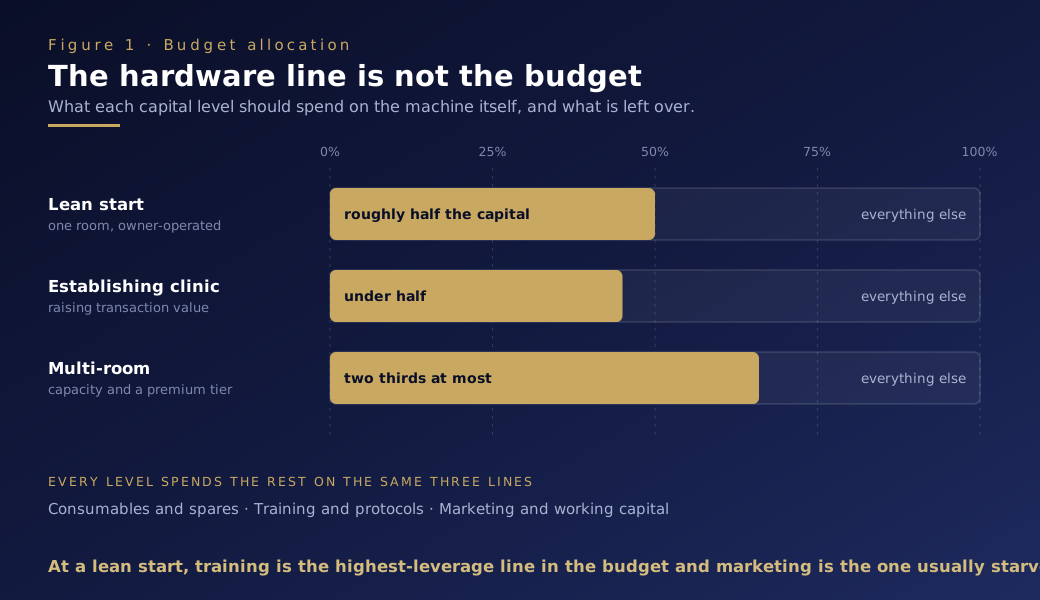
| Suggested split: hardware | Roughly half the capital | Under half | Two thirds at most |
| Suggested split: consumables and spares | Deliberately generous | Moderate | Bulk, negotiated |
| Suggested split: training and protocols | Highest-leverage line in the budget | Include therapist time as a cost | Formal programme, possibly on-site |
| Suggested split: marketing and working capital | Do not starve this | Sustained | Launch budget per new service |
| Buying directly from the factory | Usually essential to the maths | Worth the lead time | Also unlocks own-brand configuration |
Lean Start: Buy Breadth, Not Prestige
With limited capital the objective is coverage — one machine that performs several functions competently beats one function performed beautifully. Multi-technology platforms exist for this reason: a facial or body system with several handpieces can serve entry and connector roles from a single footprint, one training curve and one service contract.
Two things to insist on at this stage. First, published consumable economics, because at low volume the per-treatment cost is your margin — see how cartridge coding shifts that cost to you. Second, real training access, because an owner-operator with one machine has no colleague to learn from. Our training programme exists for exactly this situation.
Good starting points in our range: YOUNG FACIAL RF for a facial-led entry service, KOLI-FACIAL where the menu is cleanse-and-infuse, or LINKETS HIFU if lifting is the service you want to build around.
Establishing Clinic: Add the Anchor, Keep the Floor
You already have clients; the constraint is transaction value. This is where the high-ticket treatment earns its place — a professional lifting or resurfacing platform that a competitor without one cannot quote.
Two allocation traps at this level. The first is buying the anchor and spending nothing on the consumables that let you promote it aggressively. The second is buying a machine whose results depend entirely on one experienced operator, which caps your throughput at that person's diary. Look for parameter logic you can teach, real-time feedback on skin response and genuine safety cut-offs — the SYNCHROLIFT HIFU-RF ELITE and CPT TIME PRINCESS are built on that principle.
Body-focused practices at this stage should read our body sculpting launch guide before choosing between HIFEM, vacuum RF and cavitation.
Multi-Room: Sequence, Do Not Sprawl
With capital available the mistake is parallel purchasing — several machines arriving in the same month, none of them trained on, all of them competing for the same clients. Add one capability at a time, get it earning, then add the next.
This is also the level at which the asset decision changes shape. Ask whether a second unit should be a duplicate of your best performer — simpler training, shared consumables, interchangeable booking — rather than something new. And this is where direct factory relationships start paying structurally: volume pricing, spare-part stock held for you, and own-brand configuration if you are building a chain identity.
The Three Rules That Hold at Every Level
- No machine alone. Every device must chain into at least one other service you already run. An isolated machine has to fund its own client acquisition, and that is a second budget nobody planned.
- Working capital is not slack. Money left unspent is not a failure of ambition; it is what lets you survive a slow quarter and buy consumables without distress. Starving it to buy a better machine is how new clinics close in month eight.
- Do not buy a discount. A machine materially below market price is usually cheaper for a reason: grey-channel stock with no enforceable warranty, unknown component life, or documentation that will not clear customs. The full picture is in our verification guide.
What to Do Next
Write your menu first, then your machine list, then your budget — in that order. Most clinics do it backwards, which is why the flagship machine and the empty diary coexist.
Tell us your room count, your existing services and the capital you can actually commit, and we will tell you what we would buy — including the occasions when the honest answer is fewer machines than you planned. Start at the catalogue or go straight to the conversation.
Frequently Asked Questions
How much of my budget should go on the machine itself?
Cap any single machine at a modest share of the total and keep the rest for the lines that decide whether it earns: consumables and spares, training and protocols, marketing, and working capital. The relative weighting matters far more than the absolute figures — a smaller first machine that leaves budget for everything around it beats a flagship standing idle with no trained operator and no marketing behind it.
How many machines should a new clinic buy to start?
Start with one versatile platform, one clearly named entry service, and enough consumable and training budget left to actually run it. At limited capital the objective is coverage rather than prestige: a multi-technology system that performs several functions competently beats one function performed beautifully, because it means one footprint, one training curve and one service contract.
Should every machine on my floor have a defined role?
Yes — assign each candidate to entry, anchor or connector before you buy. An entry service brings first-time clients in, an anchor carries your positioning and transaction value, and a connector combines with both to turn single appointments into protocols. A machine you cannot place in one of those roles inside your existing menu is a hobby purchase, and should be labelled that way before payment rather than justified afterwards.
Is it worth buying equipment at a heavy discount?
Usually not, because a machine materially below market price is cheaper for a reason: grey-channel stock with no enforceable warranty, unknown component life, or documentation that will not clear customs. The gap between that and a properly supported unit is typically smaller than the risk it carries, and the cost shows up later as downtime nobody will cover.