
Linear and Dot are not two energies — they are two ways of placing the same energy. When a spec sheet lists "Linear + Dot" or badges a machine "7D", it is describing the geometry of the treatment points, not a different or stronger kind of ultrasound. Here is what each pattern does, where each one wins, and why a dual-mode platform exists.
The Physics Is Identical
Every professional HIFU transducer — linear or dot — focuses micro-ultrasound into a tiny focal volume beneath the skin. At that focus the tissue heats briefly and forms a thermal coagulation point (TCP). The points sit at a depth fixed by the cartridge, and the body responds by contracting existing collagen and remodelling new collagen over the following weeks. Nothing about that mechanism changes between linear and dot.
What changes is where the points land relative to each other, and how big a contact tip the handpiece presses against the skin. If you want the depth story — why 1.5, 3.0 and 4.5 mm reach different layers — read our companion guide on HIFU treatment depths. This article is about the pattern, not the depth.
Linear: A Continuous Line of Points
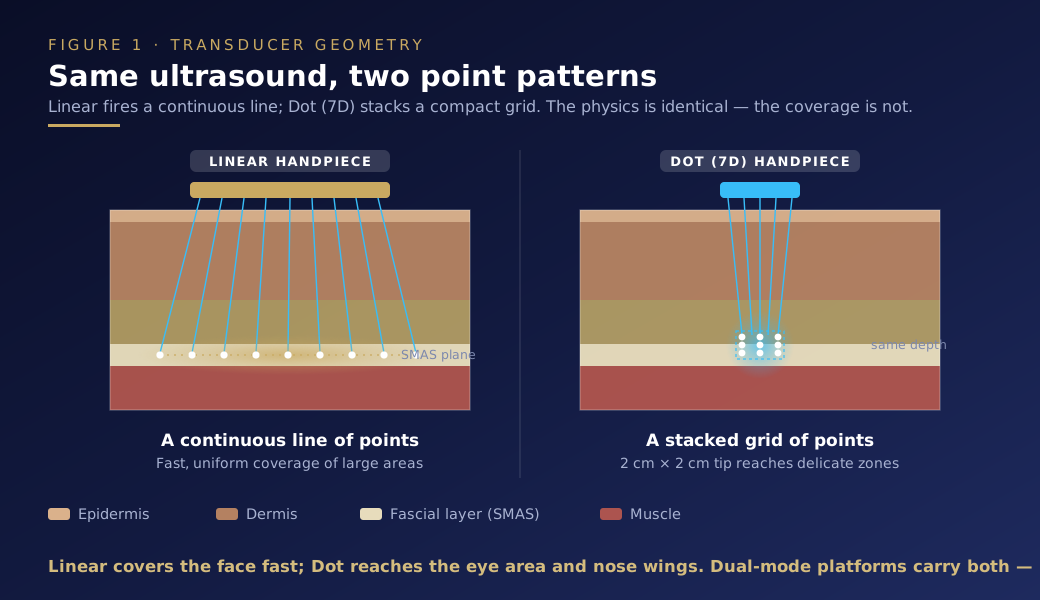
A linear handpiece fires a row of coagulation points in a continuous line as it glides across the skin. The tip is wide, so each pass lays down an even strip of treatment. That makes it the fast, uniform choice for large, relatively flat areas — the full face, the neck, the decolletage and body zones.
On the KOLIFU HIFU PRO, the Linear handpiece delivers continuous line energy for full-face and body coverage, and each Linear cartridge is rated at 5,000 lines. "Lines" is the unit you will see quoted for linear cartridges — one line is one fired row of points.
Dot (7D): A Stacked Grid of Points
A dot handpiece concentrates focused points into a compact, stacked grid instead of a long line. The contact tip is small — on the HIFU PRO it is 2 cm × 2 cm — so it can sit flat against tight curves and small zones a wide linear tip simply cannot reach: the eye area, the nose wings, the nasolabial folds. Each Dot cartridge on that platform is rated at 10,000 lines.
"7D" is the marketing label you will see for this stacked-dot delivery. It names the point pattern; it does not name a new physics, and a higher "D" number is not a power rating. Judge the handpiece by its tip geometry and its cartridge spec, not by the badge.
Side by Side
| Linear | Dot (7D) | |
|---|---|---|
| Point pattern | Continuous row (a line) | Compact stacked grid |
| Contact tip | Wide | Small (e.g. 2 cm × 2 cm) |
| Best zones | Full face, neck, body — large flat areas | Eye area, nose wings, nasolabial folds |
| Coverage style | Fast, uniform strips | Precise, concentrated spots |
| Cartridge unit (HIFU PRO) | 5,000 lines per cartridge | 10,000 lines per cartridge |
| Energy mechanism | Identical — micro-focused ultrasound, thermal coagulation at a cartridge-set depth | |
Why "No Dead Zones" Needs Both
A wide linear tip is excellent on a flat cheek and poor on the curve of the eye socket — it cannot make full contact, so energy coupling drops exactly where the skin is thinnest and the result matters most. A small dot tip solves the contact problem, but covering a whole face with a 2 cm tip alone is slow. The two patterns are complementary, not competing.
That is the case for a dual-mode platform. The KOLIFU HIFU PRO carries both Linear and Dot handpieces in one system, so the operator switches from fast large-area lifting to precision spot work without changing machine — the manufacturer's "360° no-dead-zone" claim is really a statement about tip geometry: every part of the face has a handpiece that can contact it properly.
Cartridge Economics: Lines Versus Points
Linear and dot use separate cartridges with different shot counts, so they wear at different rates depending on your menu. A practice that mostly does full-face lifting burns linear cartridges faster; one built around delicate-zone work burns dot cartridges faster. When you compare machines, ask for the shot count per cartridge for each mode and the long-term availability of replacements — not just a single "shots" number on the box.
We cover the consumable side in depth in Consumable Lock-In: how cartridges set the price and HIFU machine total cost of ownership. The short version: a dual-mode machine is two consumable lines to plan for, and that planning belongs in your cost per treatment from day one.
Comfort and Technique
Stacked-dot delivery can feel faster and more comfortable on small zones because the energy is concentrated and the pass count is lower; linear delivery is even and predictable across broad areas. Comfort also depends on contact cooling — the HIFU PRO uses forced-air plus semiconductor cooling — and on adjustable energy (0.5–2.0 J/cm² on that platform). Whatever the pattern, safe treatment comes from the same discipline: correct depth selection, correct energy for the tissue, and avoiding nerve-dense zones. Operator training matters more than the mode badge.
Which Should Your Practice Choose?
- Mostly large-area face and neck lifting: a linear-capable machine covers it fastest.
- A menu built around the eye area, nose wings and nasolabial folds: you need a dot tip that can contact those curves.
- A full-face practice that treats every zone: a dual-mode platform carrying both is the cleanest answer — one machine, no dead zones.
For the wider purchase decision — depths, certifications, supplier vetting and the full factor list — follow our HIFU machine buying guide, or browse the KOLIFU HIFU collection and request factory-direct pricing.
Frequently Asked Questions
Is Dot (7D) HIFU stronger than Linear HIFU?
No. Both use the same micro-focused ultrasound physics and create thermal coagulation points at a cartridge-set depth. The difference is the spatial pattern and the tip geometry, not the energy type or a higher power rating.
Can a Linear-only machine treat the eye area and nose wings?
Only within limits. A wide linear tip cannot sit flat against tight curves and small zones, so contact and energy coupling suffer there. A compact dot tip is designed to reach those delicate areas.
Do Linear and Dot handpieces use the same cartridges?
No. They are separate cartridges with different shot counts. On the KOLIFU HIFU PRO, each Linear cartridge delivers 5,000 lines and each Dot cartridge delivers 10,000 lines; the system ships with three of each.
What does 7D mean in HIFU marketing?
7D is a marketing label for stacked-dot delivery, where focused points are placed in a compact grid rather than a single continuous line. It describes the point pattern, not a different physical mechanism.
Is a dual-mode HIFU machine worth it?
If you treat the whole face including delicate zones, yes. Carrying both handpieces in one platform gives fast large-area coverage plus precision reach, so no part of the face is left untreated for lack of a suitable tip.